
Caching Strategies
Caching strategies determine how data is stored, retrieved, and synchronized between the cache and the database. Choosing the correct strategy helps balance performance, consistency, scalability, and reliability within a system.
Read-Through Cache
A strategy designed to handle read operations from the cache only. Write operations always go directly to the database.
How It Works?
| Operation | Flow |
|---|---|
| Read (Cache Hit) | Request → Cache → Response |
| Read (Cache Miss) | Request → Cache (Miss) → Database → Store in Cache → Response from Cache |
| Write | Request → Database directly (Cache is not updated) |
Key Points
- Data is never written to the cache explicitly; it is populated only when a cache miss occurs.
- The first read for any data always results in a cache miss.
- Subsequent reads are served directly from the cache.
- Best suited for read-heavy workloads where write data does not need to be cached.
Example
Product listings displayed to users are cached for fast retrieval. Order placement requests go directly to the database because they are write operations that are not frequently read by users.
Write-Through Cache
A strategy where data is written to the cache first and then synchronously written to the database.
How It Works?
| Operation | Flow |
|---|---|
| Write | Request → Cache (Updated) → Database (Updated) |
| Read | Request → Cache → Response |
Key Points
- Cache always contains the latest and most consistent data.
- Write latency is slightly higher because both cache and database are updated on every write.
- Ensures strong consistency between cache and database.
- Read operations are extremely fast since data is already available in the cache.
Example
Stock market values that must always reflect the latest price. Every update is written to the cache first and then persisted to the database.
Write-Around Cache
A strategy where write operations go directly to the database, bypassing the cache entirely. Reads are served from the cache.
How It Works?
| Operation | Flow |
|---|---|
| Write | Request → Database directly (Cache is not updated) |
| Read (Cache Hit) | Request → Cache → Response |
| Read (Cache Miss) | Request → Cache (Miss) → Database → Store in Cache → Response from Cache |
Key Points
- Cache is not polluted with data that may never be read.
- Useful when newly written data is unlikely to be accessed immediately.
- Improves cache efficiency by storing only frequently accessed data.
- Risk of stale data if cached entries are not invalidated after database updates.
Example
Logging systems where large volumes of data are written continuously, but only a small portion is read later.
Write-Back Cache (Write-Behind)
A strategy where data is written only to the cache during the request. The database is updated later through an asynchronous process.
How It Works?
| Operation | Flow |
|---|---|
| Write | Request → Cache (Updated Immediately) → Database (Updated Asynchronously) |
| Read (Cache Hit) | Request → Cache → Response |
| Read (Cache Miss) | Request → Cache (Miss) → Database → Store in Cache → Response from Cache |
Key Points
- Prioritizes performance over immediate consistency.
- Provides very low write latency.
- Ideal for systems experiencing high write traffic.
- Risk of data loss if the cache fails before the asynchronous database update completes.
Example
In a food delivery application, order-tracking status updates change frequently. Updates are written immediately to the cache for fast access, while the database is updated asynchronously in the background.
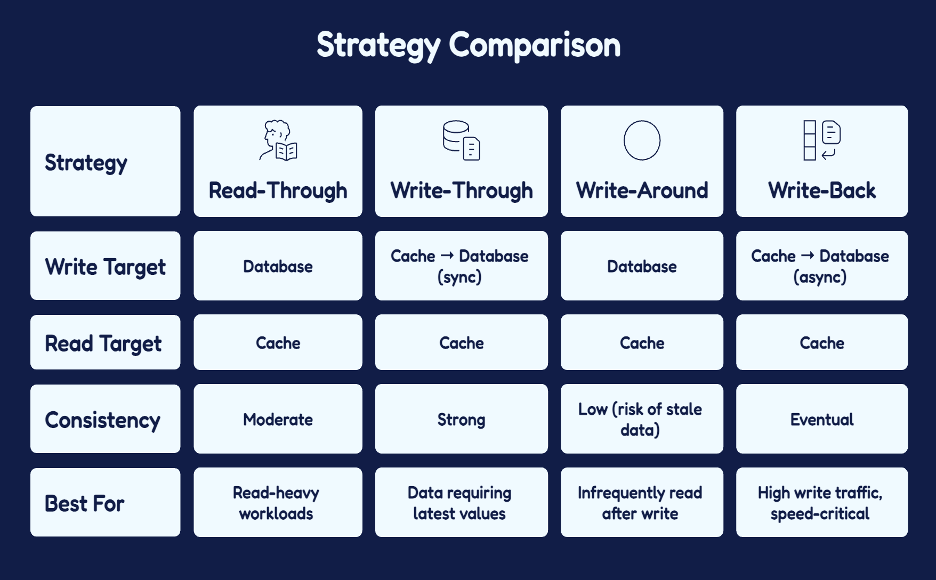
Summary
- Caching strategies define how data is read from and written to the cache and database, balancing performance, consistency, and scalability.
- Read-Through Cache is optimized for read-heavy workloads, loading data into the cache only when a cache miss occurs.
- Write-Through Cache provides strong consistency by updating both the cache and database synchronously, ensuring the cache always contains the latest data.
- Write-Around Cache writes data directly to the database, preventing unnecessary cache usage for data that is unlikely to be read immediately after being written.
- Write-Back Cache (Write-Behind) offers the highest write performance by updating the cache immediately and persisting data to the database asynchronously, trading immediate consistency for speed.
Written By: Muskan Garg
How is this guide?
Last updated on