
Types of NoSQL Databases
NoSQL databases provide alternative ways of storing and retrieving data, allowing systems to achieve better scalability, flexibility, and performance.
NoSQL databases are categorized into four main types based on how they store and retrieve data:
- Key-Value Databases
- Columnar Databases
- Graph Databases
- Document Databases
Each type solves a different set of problems and is widely used in modern system design
Key-Value Pair Database
A Key-Value database stores data in the form of a unique key and its corresponding value.
- Key - Must be unique (acts as an identifier)
- Value - Can contain any type of data
Supported Value Types
| Value Type | Example |
|---|---|
| String | "hello world" |
| Number | 42, 3.14 |
| JSON | {"name": "Alice"} |
| Array | [1, 2, 3] |
| Object | Nested objects |
| BLOB | Binary large objects (images) |
| Byte[] | Raw byte arrays |
Key Characteristics
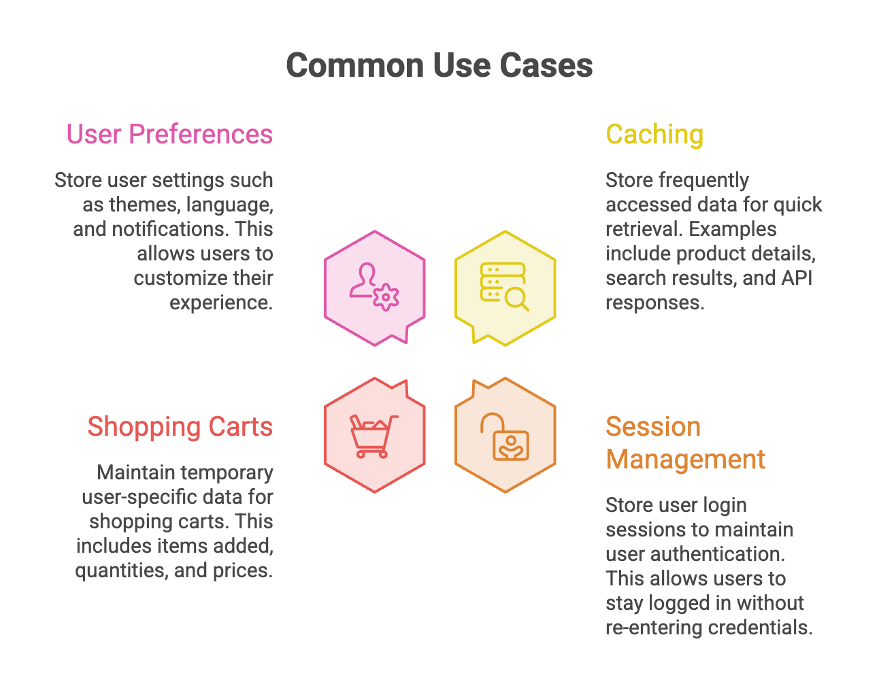
- No fixed structure required
- No relationships to maintain
- Values can be nested objects, arrays, or combinations of multiple data types
Example: Blog Post Stored as Key-Value
{
  "posts": [
    {
      "post_id": 1,
      "content": "anyText",
      "comments": [
        {
          "comment_id": 1,
          "comment": "nice"
        }
      ]
    }
  ]
}
All related data (post + comments) lives together in a single value and no joins needed.
Popular Key-Value Databases
- Redis
- Amazon DynamoDB
- Memcached
Columnar Database
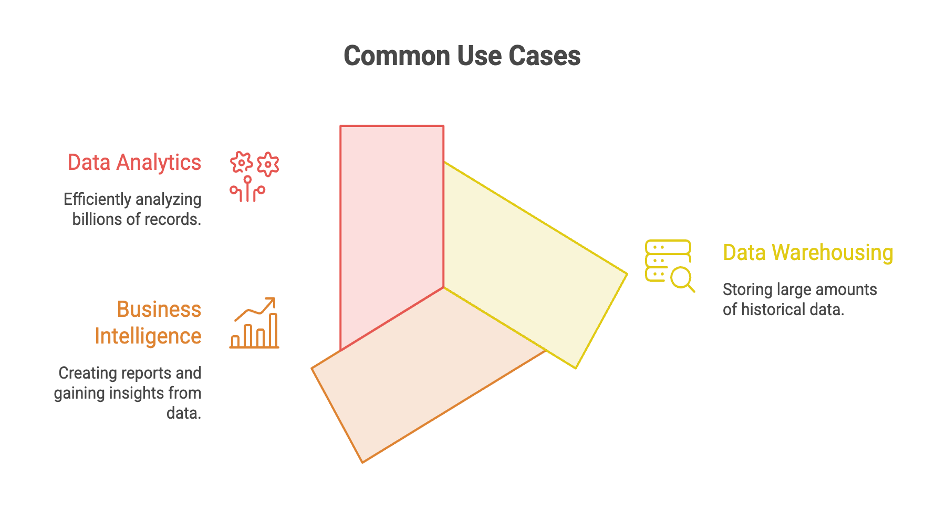
Traditional SQL databases read data row-wise (left to right). Columnar databases read data column-wise (top to bottom), enabling efficient aggregation and analytics.
How Does It Work?
Students Table:
| id | name | marks |
|---|---|---|
| 1 | Alice | 85 |
| 2 | Bob | 72 |
| 3 | Charlie | 90 |
Task: Calculate the average marks of the class.
| Approach | How It Reads | Efficiency |
|---|---|---|
| SQL (Row-wise) | Reads id, name, marks for every row | Reads unnecessary columns (id, name) |
| Columnar DB | Reads only the marks column: [85, 72, 90] | Reads only what's needed |
Key Characteristics
| Operation | Performance | Reason |
|---|---|---|
| Reading | Faster | Only relevant columns are scanned |
| Writing | Slower | Data must be written column by column (id → name → marks → ...) |
Use Cases
- Data analytics and aggregations
- Business intelligence and reporting
- Large-scale data warehousing
Popular Columnar Databases
| Database | Company |
|---|---|
| BigQuery | |
| RedShift | Amazon |
| Snowflake | Snowflake Inc. |
Columnar DBs are optimized for read-heavy analytical workloads, not for frequent writes, because data must be written separately into different column structures like id column, name column, and marks column.
Graph Database
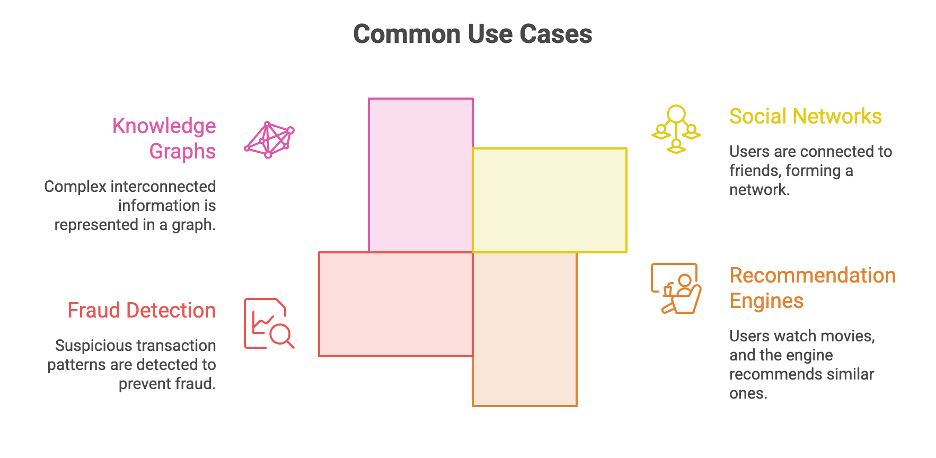
Data is represented as nodes (entities) connected by edges (relationships). Both nodes and edges can have properties.
| Component | Represents | Can Have Properties? | Examples |
|---|---|---|---|
| Node | Represents an entity (data) | Yes | Student, Course, User |
| Edge | Represents a relationship between nodes. | Yes | Student --> Enrolled In --> Course |
Example - Student-Course-College System
[Student] --Enrolled--> [Course]
[Student] --Studies-->   [College]
[College] --Provides--> [Course]
Node Properties:
| Node | Properties |
|---|---|
| Student | id, name, age, department |
| Course | id, name, duration, credits |
| College | id, name, location |
Edge Properties:
| Edge | Connects | Properties |
|---|---|---|
| Enrolled | Student → Course | year, marks, year_of_passing |
| Studies | Student → College | batch, enrollment_year |
| Provides | College → Course | semester, faculty |
Key Characteristics
- Two entities can have multiple different relationships
- Entities can be connected to many other entities
- Ideal for finding patterns and connections between data
- Can be slower due to maintaining multiple nodes and edges with properties
Popular Graph Databases
- Gremlin
- SparQL
- Cypher (Neo4j)
Document Database
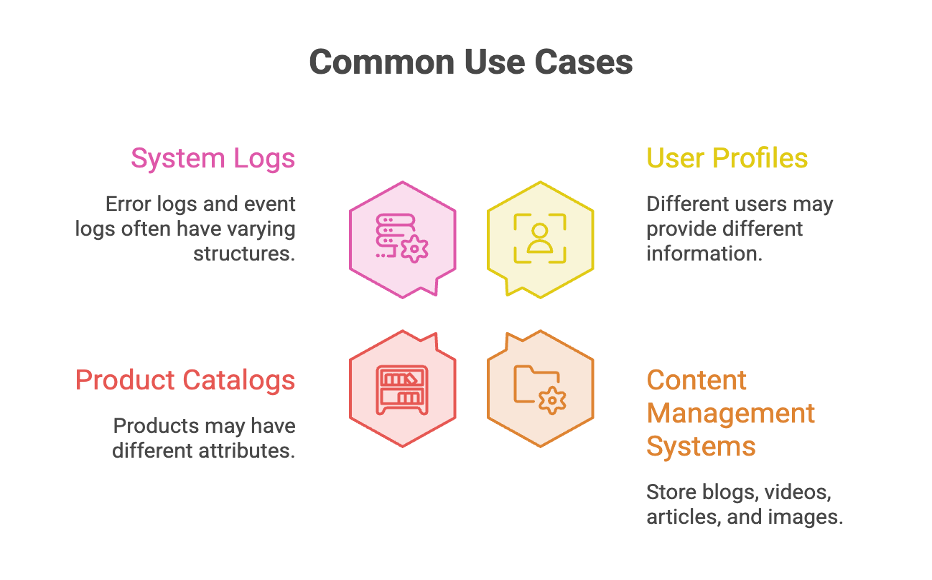
Data is stored as documents ( JSON/BSON format). Each document can have a different structure, and thus no fixed schema is required.
Key Characteristics
- Flexible and schema-less - each document can have different fields
- Data can be stored with any length and structure
- No need to follow a predefined schema
- Retrieval of data is fast due to self-contained documents
Example - User Profiles with Varying Data
// User 1: Minimal data
{
  "user_id": "u1",
  "name": "Alice",
  "email": "alice@mail.com"
}

// User 2: Detailed data
{
  "user_id": "u2",
  "name": "Bob",
  "email": "bob@mail.com",
  "phone": "+1234567890",
  "address": { "city": "NYC", "zip": "10001" },
  "social": { "twitter": "@bob", "github": "bob-dev" }
}
Both documents coexist in the same collection despite different structures.
Popular Document Databases
- MongoDB
- CouchDB
NoSQL Database Comparison
| Type | Data Model | Read Speed | Write Speed | Best For |
|---|---|---|---|---|
| Key-Value | Key → Value | Very Fast | Fast | Caching, sessions, simple lookups |
| Columnar | Column-oriented | Fast (analytics) | Slow | Aggregations, data warehousing |
| Graph | Nodes + Edges | Moderate | Moderate | Relationships, pattern detection |
| Document | JSON Documents | Fast | Fast | Flexible schemas, logging |
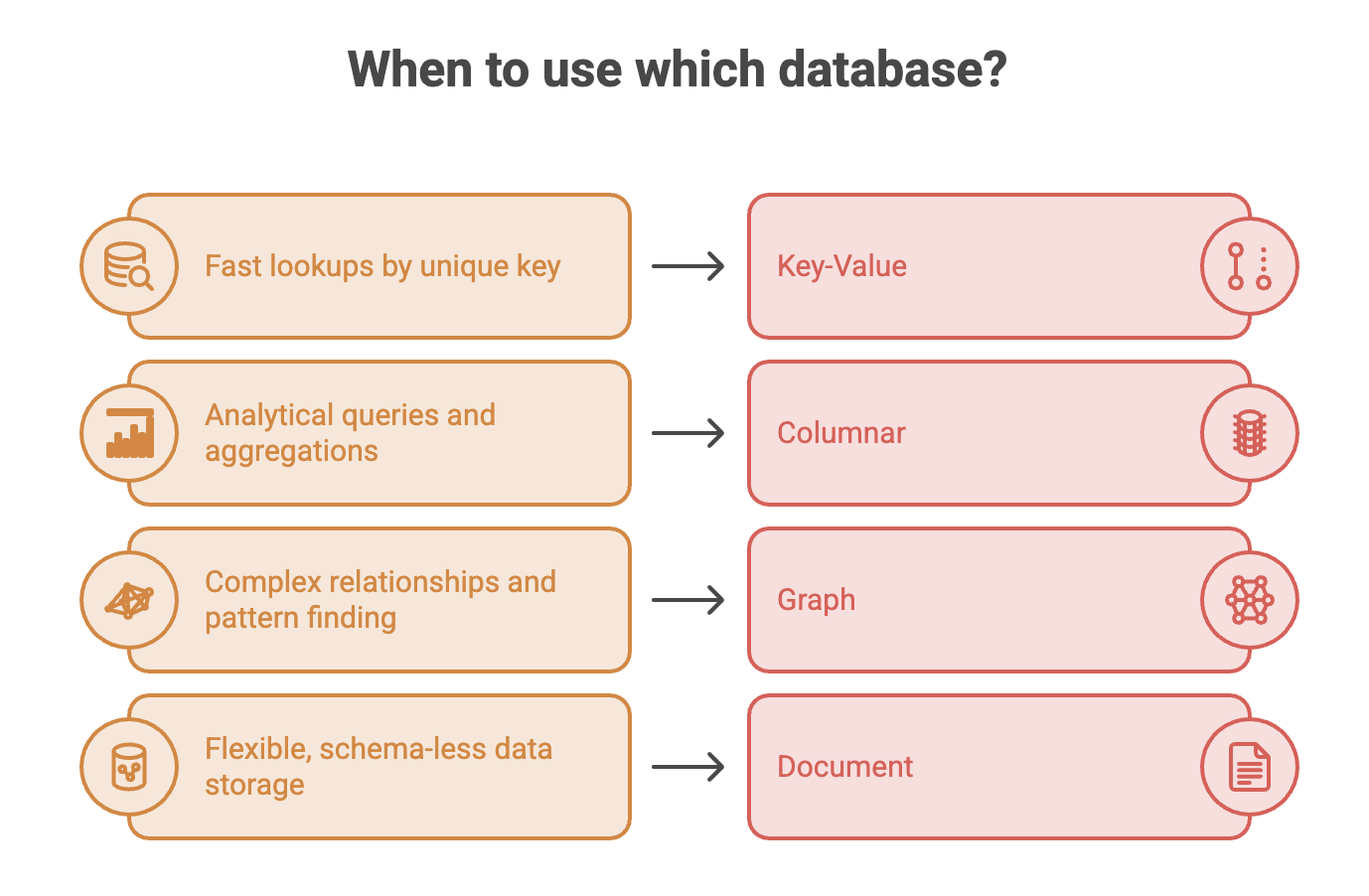
Summary
- NoSQL databases are designed to address scalability, flexibility, and performance challenges that traditional relational databases may face at large scale.
- Key-value databases provide extremely fast access and are ideal for caching and session management.
- Columnar databases are optimized for analytical workloads and large-scale reporting systems.
- Graph databases excel at managing and analyzing relationships between interconnected entities.
- Document databases offer schema flexibility and are widely used for content platforms, user profiles, and modern web applications.
- Selecting the right NoSQL database depends on the application's access patterns, scalability requirements, and data model.
Written By: Muskan Garg
How is this guide?
Last updated on