
Relational Databases
Data is one of the most valuable assets in any software application. Whether it is a social media platform, an e-commerce website, a banking system, or a learning management platform, all applications need a reliable way to store, organize, and retrieve data.
Broadly, databases can be categorized into two major types:
| Approach | Database Type | Examples |
|---|---|---|
| SQL | Relational Databases (RDBMS) | PostgreSQL, MySQL, Oracle, SQL Server |
| NoSQL | Non-Relational Databases | MongoDB, Cassandra, Redis, Neo4j |
Relational databases are among the most widely used storage systems because they provide a structured way of organizing data and maintaining relationships between different entities.
What is a Relational Database?
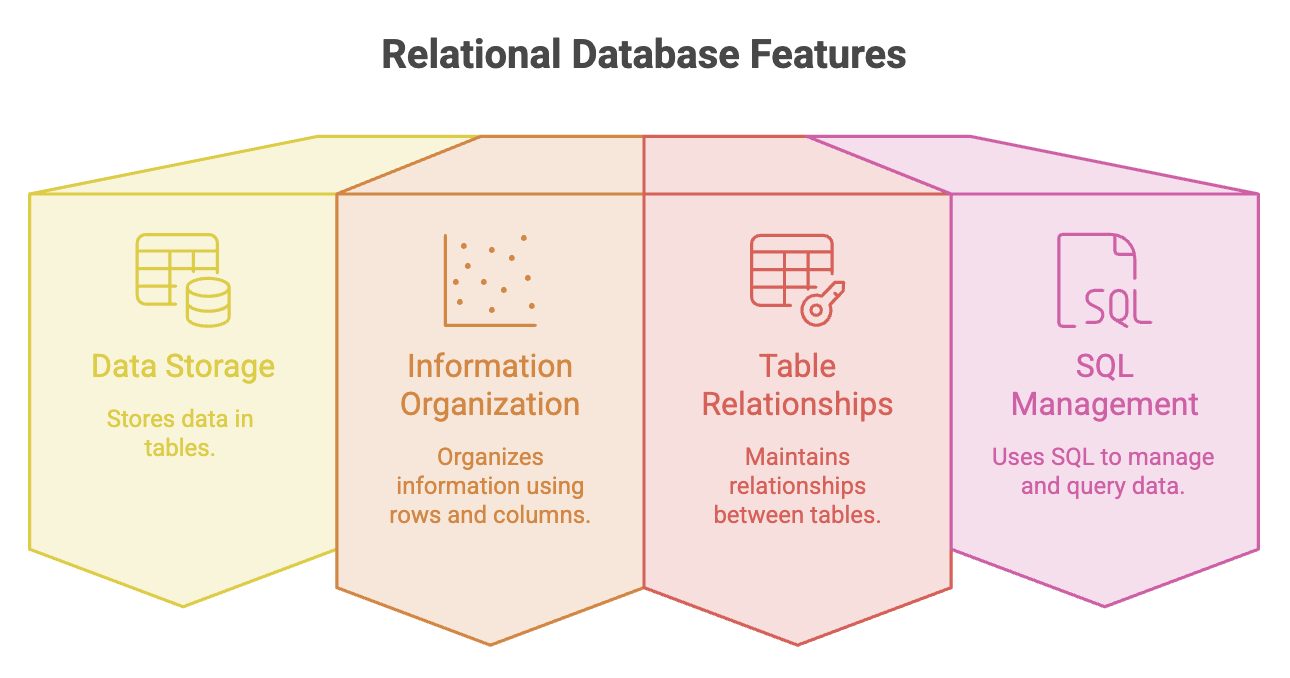
A Relational Database Management System (RDBMS) stores data in the form of tables consisting of rows and columns.
The term relational comes from the ability to create relationships between multiple tables.
For example, in a blogging platform:
- Users create posts
- Posts receive comments
- Comments are written by users
All these entities are related to one another and can be connected using relational database concepts.
Why Relational Databases?
Relational databases are designed to solve common data management challenges:
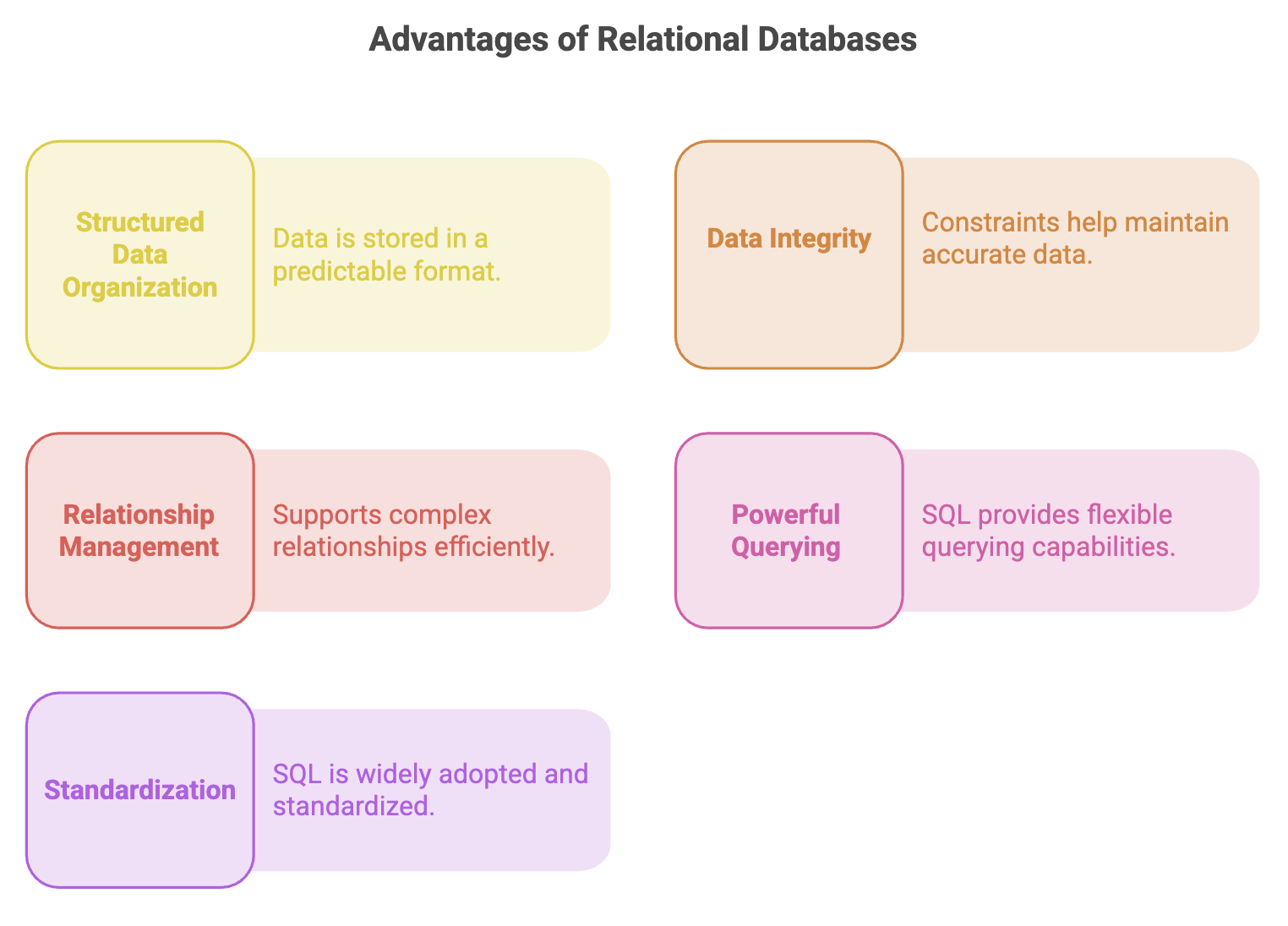
- Organizing large amounts of structured data
- Preventing duplicate data
- Maintaining data consistency
- Supporting complex relationships
- Enabling efficient querying
They are ideal when:
- Data has a predefined structure
- Relationships between data are important
- Data integrity and consistency are critical
Core Building Blocks of Relational Databases
Understanding relational databases starts with understanding their fundamental components.
Entity
An Entity represents a real-world object or concept about which information is stored.
Examples:
- User
- Product
- Order
- Employee
- Student
- Course
- Video
- Comment
In relational databases, each entity is usually represented as a table.
Example
Consider a social media application.
Possible entities:
Users
Posts
Comments
Likes
Messages
Each of these entities stores a specific type of information.
Table
A Table is a collection of related data organized into rows and columns.
Each table represents one entity.
Example: Users Table
| id | first_name | last_name | mobile |
|---|---|---|---|
| 1 | Rahul | Sharma | 9876543210 |
| 2 | Priya | Verma | 9123456789 |
| 3 | Amit | Patel | 9988776655 |
This table stores information related to users.
Attributes (Columns)
Attributes define the properties of an entity.
They are represented as columns in a table.
Example
For a User entity:
| Attribute |
|---|
| id |
| first_name |
| last_name |
| mobile |
Each attribute describes a specific characteristic of a user.
Real-World Analogy
Consider a student.
A student may have:
- Student ID
- Name
- Phone Number
- Date of Birth
These properties become attributes (columns) in a database table.
Records (Rows)
A Record represents a complete instance of an entity.
Each row contains values for all attributes.
Example
| id | first_name | last_name | mobile |
|---|---|---|---|
| 1 | Rahul | Sharma | 9876543210 |
This entire row represents one user record.
Example: Blog Application Database
A blogging platform may contain multiple entities.
Users Table
| id | first_name |
|---|---|
| 1 | Rahul |
| 2 | Priya |
Posts Table
| id | user_id | title |
|---|---|---|
| 1 | 1 | System Design Basics |
| 2 | 2 | SQL vs NoSQL |
Comments Table
| id | post_id | user_id | comment_text |
|---|---|---|---|
| 1 | 1 | 2 | Great explanation! |
| 2 | 1 | 1 | Thank you! |
Each table stores a different type of information while maintaining relationships with other tables.
Naming Conventions
Following standard naming conventions improves readability and maintainability.
Table Names
Table names are generally written in plural form.
Examples:
users
posts
comments
orders
products
Reason:
A table stores multiple records, not a single record.
Column Names
Column names should:
- Be descriptive
- Use singular form
- Clearly indicate stored information
Examples:
first_name
last_name
mobile
created_at
updated_at
Primary Key
Most tables contain a unique identifier.
Example:
idThis uniquely identifies every row in the table.
Relationships in Relational Databases
The most powerful feature of relational databases is the ability to create relationships between entities.
These relationships connect tables and allow data to be linked logically.
Why Relationships Are Needed
Consider a blogging platform.
Questions we may want to answer:
- Which user created a post?
- Which comments belong to a post?
- Which user wrote a comment?
Relationships help answer these questions efficiently.
SQL and Relational Databases
Relational databases use SQL (Structured Query Language) to interact with data.
SQL allows us to:
- Create tables
- Insert records
- Retrieve data
- Update data
- Delete data
Common SQL Operations
| Operation | Purpose |
|---|---|
| CREATE | Create tables |
| INSERT | Add records |
| SELECT | Retrieve data |
| UPDATE | Modify data |
| DELETE | Remove data |
These operations form the foundation of database interactions.
When to Use Relational Databases?
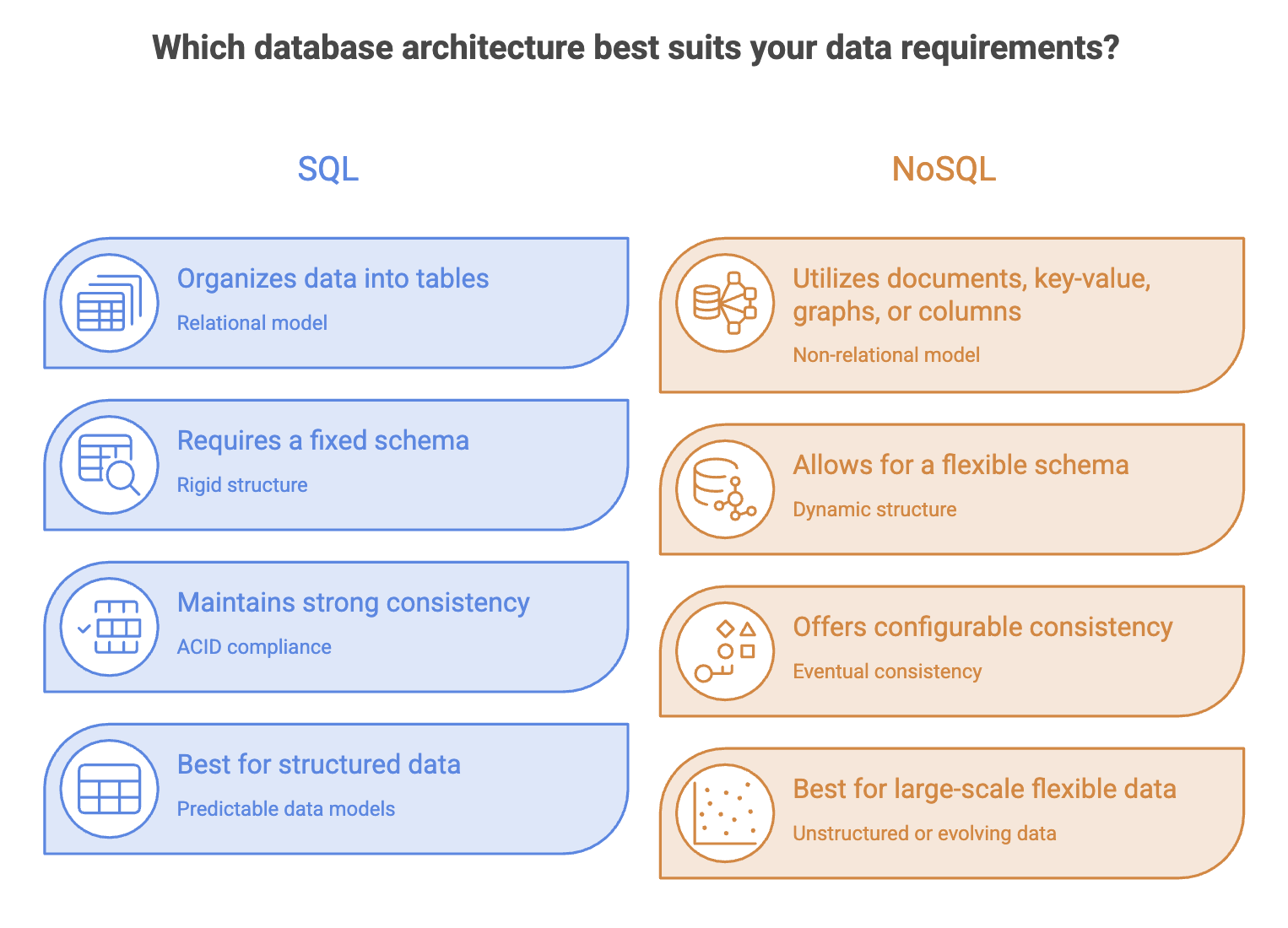
Relational databases are preferred when:
- Data is highly structured
- Relationships are important
- Data consistency is critical
- Transactions must be reliable
- Business rules need strict enforcement
Examples:
- Banking Systems
- E-commerce Platforms
- ERP Systems
- Student Management Systems
- Inventory Management Applications
Summary
- Relational databases organize data into structured tables consisting of rows and columns.
- An entity represents a real-world object and is typically mapped to a database table.
- Attributes define the properties of an entity, while records store actual data instances.
- Table names are generally written in plural form, while columns represent individual fields of the entity.
- Relationships allow tables to be connected and are categorized as one-to-one, one-to-many, and many-to-many.
- Foreign keys establish relationships between tables and maintain referential integrity.
- SQL is the standard language used to create, query, update, and manage relational data.
- Relational databases are best suited for structured data, strong consistency requirements, and applications with complex relationships.
Written By: Muskan Garg
How is this guide?
Last updated on