
NoSQL Databases
As applications grow to millions of users and handle massive amounts of data, traditional relational databases can become difficult to scale efficiently. Modern systems such as social media platforms, e-commerce websites, streaming services, and real-time applications often require databases that can scale horizontally, handle flexible data structures, and provide high performance.
NoSQL databases are designed to overcome many of the scalability and flexibility challenges faced by traditional relational databases.
The Problem with Relational Databases at Scale
Consider a Blog Application with the following relational schema:
| Table | Columns |
|---|---|
| Posts | id, content |
| Content | id, type (image/text/video) |
| Images | id, data |
| Texts | id, data |
| Videos | id, data |
| Comments | id, comment, post_id, user_id |
| Users | id, name |
This results in 6+ tables with multiple relationships. As the blog grows in size, maintaining these relationships and scaling becomes increasingly difficult.
Scaling Databases
1. Vertical Scaling
Vertical scaling means increasing the capacity of a single server.
Examples: More RAM, Faster CPU, Larger storage, Better hardware
Advantages
- Simple to implement
- No major application changes
Limitations
- Expensive
- Physical hardware limits exist
- Eventually reaches a maximum capacity
2. Horizontal Scaling
Horizontal scaling means distributing data across multiple servers.
Examples: Instead of one server: Server 1, Server 2, Server 3, Server 4. The workload is distributed among all servers.
Advantages
- Nearly unlimited scalability
- Better fault tolerance
- Improved availability
Challenges in SQL Databases
When data is distributed across multiple servers:
- Joins become complex
- Foreign key relationships become difficult to maintain
- Cross-server queries become slower
What is NoSQL?
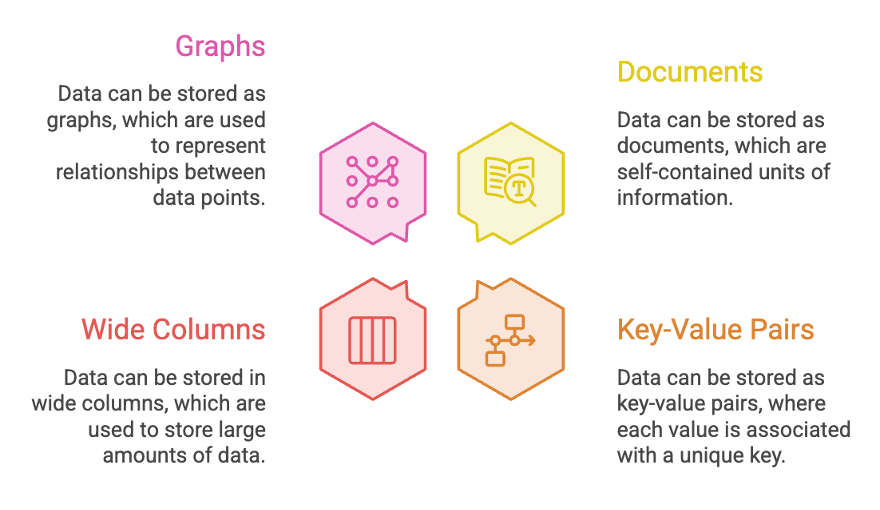
NoSQL stands for Not Only SQL. Unlike relational databases, NoSQL databases do not store data strictly in rows and columns. Data is typically stored as documents, key-value pairs, wide-column stores, or graphs, making them inherently easier to distribute.
Blog Application in NoSQL (Document Model)
Instead of 6 separate tables, a single document can represent a blog post:
{
  "post_id": "p101",
  "author": {
    "user_id": "u1",
    "name": "Alice"
  },
  "content": {
    "type": "image",
    "data": "image_url_here"
  },
  "comments": [
    { "comment_id": "c1", "text": "Great post!", "user_id": "u2" },
    { "comment_id": "c2", "text": "Very helpful.", "user_id": "u3" }
  ]
}- No joins required and all related data lives within one document.
- Easy to replicate or partition across servers.
Advantages of NoSQL Databases
1. Easy Horizontal and Vertical Scaling
NoSQL databases are designed for distributed environments.
- Data can be split across multiple servers.
- New servers can be added easily.
- High availability can be achieved.
- Large datasets can be managed efficiently
Common Techniques
- Sharding: Data is divided into smaller partitions and distributed across multiple servers.
- Replication: Copies of data are stored on multiple servers to improve reliability.
2. Schema-less (Flexible Structure)
In relational databases, table structure is fixed as you cannot have different columns for different rows.
Problem Example:
| user | content_type | data | description |
|---|---|---|---|
| user1 | image | img_url | - |
| user2 | text | text_data | - |
| user3 | java_code | code_snippet | some desc |
In SQL, every row must conform to the same schema. Adding or removing columns for individual entries is not possible without altering the entire table.
NoSQL Solution - Each document can have a different structure:
// Document 1
{ "user": "user1", "type": "image", "data": "img_url" }

// Document 2
{ "user": "user2", "type": "text", "data": "text_content" }

// Document 3
{ "user": "user3", "type": "java_code", "data": "code_snippet", "description": "Sorting algorithm" }
Each document can have a different number and type of fields within the same collection.
3. Self-Contained Entities
Every entity in NoSQL stands on its own, and there is no need to maintain complex relationships.
Example - Courses Collection:
// Document 1: Basic info
{ "course_id": "c1", "course": "System Design" }

// Document 2: With details
{ "course_id": "c2", "course": "DSA", "duration": "8 weeks", "level": "Intermediate" }

// Document 3: With lessons
{ "course_id": "c3", "course": "Backend", "lessons": ["Node.js", "Databases", "APIs"] }

// Document 4: With lessons and comments
{ "course_id": "c4", "course": "DevOps", "lessons": ["Docker", "K8s"], "comments": ["Excellent!", "Very detailed"] }
All four documents coexist in the same collection despite having different structures.
Real-World NoSQL Usage
| Company | NoSQL Database | Use Case |
|---|---|---|
| Netflix | Apache Cassandra | Tracking user activities at scale |
| Amazon | DynamoDB | Scaling e-commerce application globally |
| Facebook (Meta) | HBase | User messaging and large-scale storage |
| Uber | MongoDB | Handling flexible and real-time data |
| Twitter (X) | Redis | Caching and timeline rendering |
Summary
- NoSQL databases were created to solve scalability and flexibility challenges faced by traditional relational databases.
- They store data in formats such as documents, key-value pairs, wide columns, and graphs.
- NoSQL databases are designed for horizontal scaling and distributed architectures.
- They provide flexible schemas, making them ideal for rapidly changing applications.
- NoSQL databases reduce the need for joins by storing related information together.
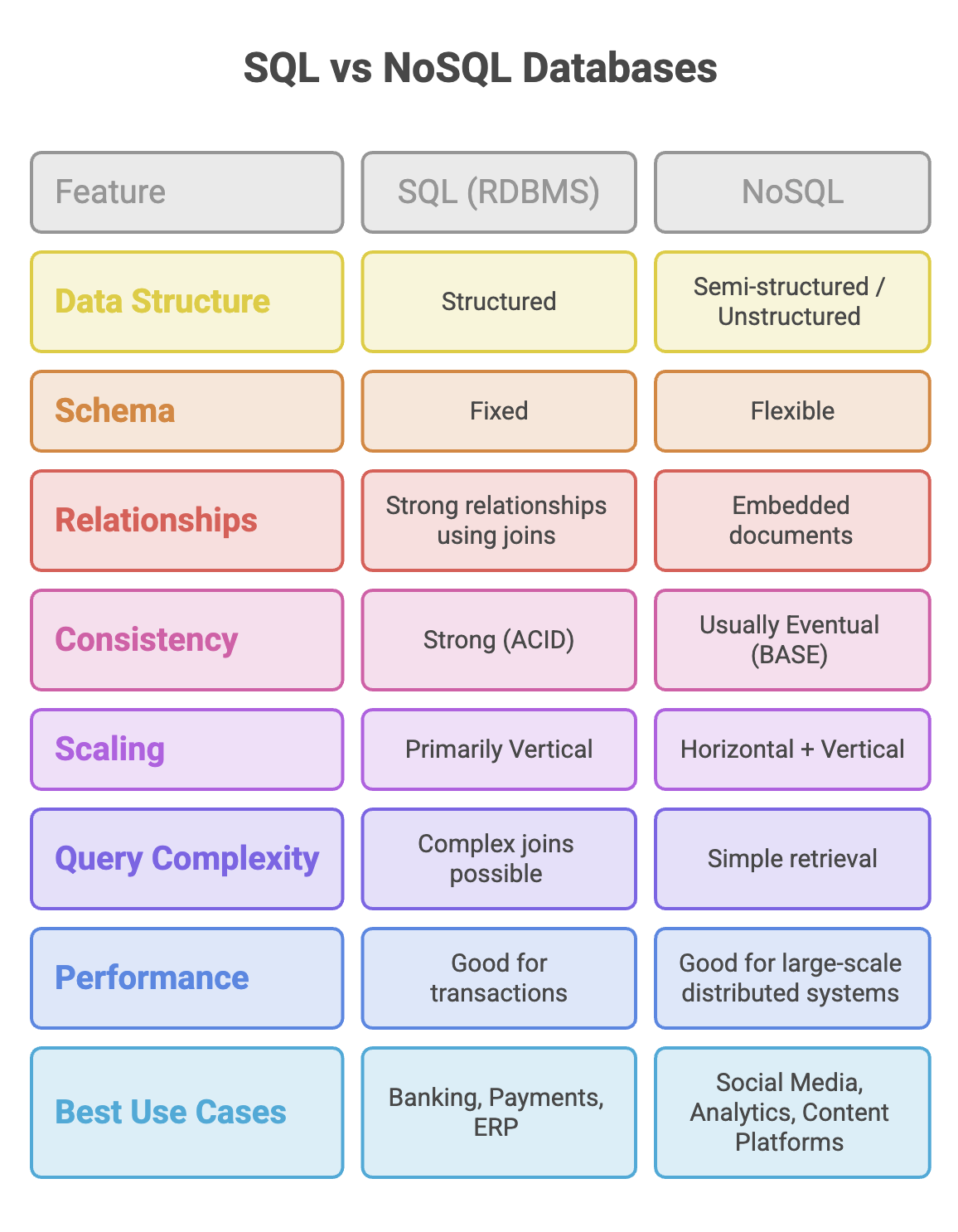
- SQL remains the preferred choice when strong consistency and complex relationships are required.
- Modern large-scale applications often use both SQL and NoSQL databases together, selecting the best tool for each specific requirement.
Written By: Muskan Garg
How is this guide?
Last updated on