
Database Joins
In relational databases, data is often distributed across multiple tables to reduce duplication and maintain consistency. However, real-world applications frequently require data from multiple tables to be combined and presented together.
A join is a SQL operation that combines data from two or more related tables based on a common column, usually a primary key and foreign key relationship.
What is a Join?
A join allows SQL queries to fetch related data stored in separate tables.
A join is a database operation that combines rows from two or more tables using a related column between them.
Why Are Joins Needed?
In a well-designed relational database:
- User information is stored in a Users table.
- Blog information is stored in a Blogs table.
- Comments are stored in a Comments table.
Instead of storing all information in a single table, data is separated into logical entities. Joins help reconnect these entities whenever related information needs to be retrieved.
In system design, understanding joins is critical because they directly impact query performance, data modeling, and scalability of the system.
Types of Table Relationships
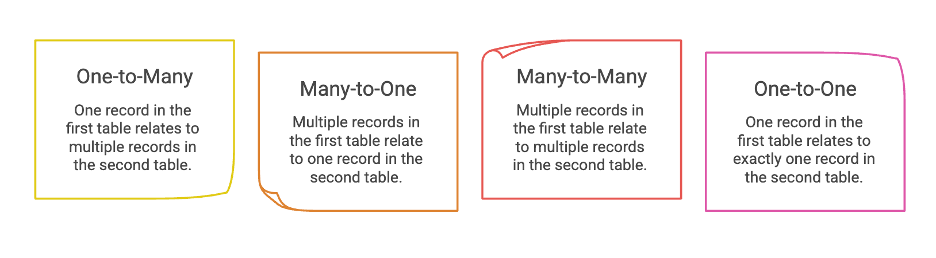
Relational databases primarily support four types of relationships:
One-to-Many Relationship
A single record in one table is associated with multiple records in another table.
Example: A User can have multiple Blogs.
Users Table:
| id | fname |
|---|---|
| 1 | Alice |
| 2 | Bob |
Blogs Table:
| id | title | user_id |
|---|---|---|
| 1 | Blog on SQL | 1 |
| 2 | Blog on NoSQL | 1 |
| 3 | Blog on Caching | 2 |
- Alice (id=1) has two blogs associated with her.
- Bob (id=2) has one blog associated with him.
user_idin the Blogs table acts as a foreign key referencing the Users table.
Many-to-One Relationship
Multiple records in one table are associated with a single record in another table. This is the inverse perspective of One-to-Many.
Example: Multiple Blogs belong to the same User.
| Blog | Belongs To |
|---|---|
| Blog on SQL | Alice |
| Blog on NoSQL | Alice |
| Blog on Caching | Bob |
- From the Blogs' perspective, many blogs point to the same user - this is Many-to-One.
- From the Users' perspective, one user has many blogs - this is One-to-Many.
One-to-Many and Many-to-One are the same relationship viewed from different directions.
Many-to-Many Relationship
Many records from one table are associated with many records from another table, and vice-versa.
Example: Students and Courses, A student can enroll in many courses, and a course can have multiple students.
Students Table:
| id | fname |
|---|---|
| 1 | Alice |
| 2 | Bob |
| 3 | Charlie |
Courses Table:
| id | name |
|---|---|
| 1 | Math |
| 2 | Science |
| 3 | History |
Junction Table - students_courses:
| id | student_id | course_id |
|---|---|---|
| 1 | 1 | 1 |
| 2 | 1 | 2 |
| 3 | 2 | 1 |
| 4 | 3 | 2 |
| 5 | 3 | 3 |
Why is a Junction Table Required?
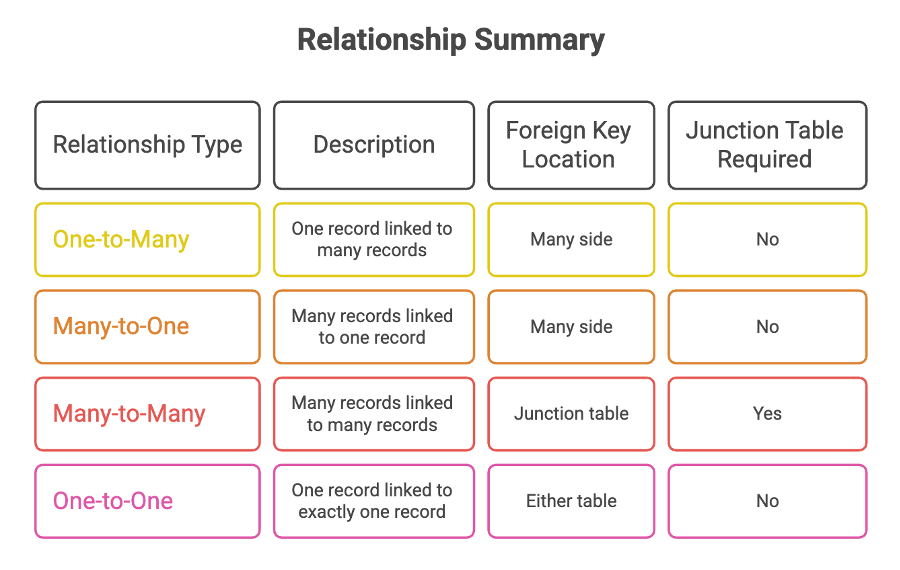
- A junction table (also called a bridge/mapping table) is required to maintain the Many-to-Many relationship.
- The junction table contains foreign keys referencing both related tables.
- From the above table:
- Alice is enrolled in Math and Science.
- Bob is enrolled in Math.
- Charlie is enrolled in Science and History.
- Math has Alice and Bob enrolled.
- Science has Alice and Charlie enrolled.
Without a junction table, there is no way to represent Many-to-Many relationships in a relational database.
One-to-One Relationship
A single record in one table is associated with exactly one record in another table.
Example: A content search table stores metadata, while the actual data resides in separate type-specific tables.
Contents Table (Searchable Metadata):
| id | name | content_id | type |
|---|---|---|---|
| 1 | Intro Video | 101 | video |
| 2 | Jazz Track | 201 | audio |
| 3 | Tech Article | 301 | blog |
Videos Table:
| id | data |
|---|---|
| 101 | (video binary data) |
Audios Table:
| id | data |
|---|---|
| 201 | (audio binary data) |
Blogs Table:
| id | data |
|---|---|
| 301 | (blog content data) |
Key Points:
content_idin the Contents table acts as a foreign key pointing to the respective data table (Videos, Audios, or Blogs).- Each content record maps to exactly one record in its corresponding data table.
- This pattern is useful when you want a unified searchable interface while keeping actual data separated by type.
Summary
-
A join combines data from multiple related tables.
-
Relational databases support One-to-Many, Many-to-One, Many-to-Many, and One-to-One relationships.
-
Foreign Keys connect related tables and make joins possible.
-
Many-to-Many relationships require a junction table.
-
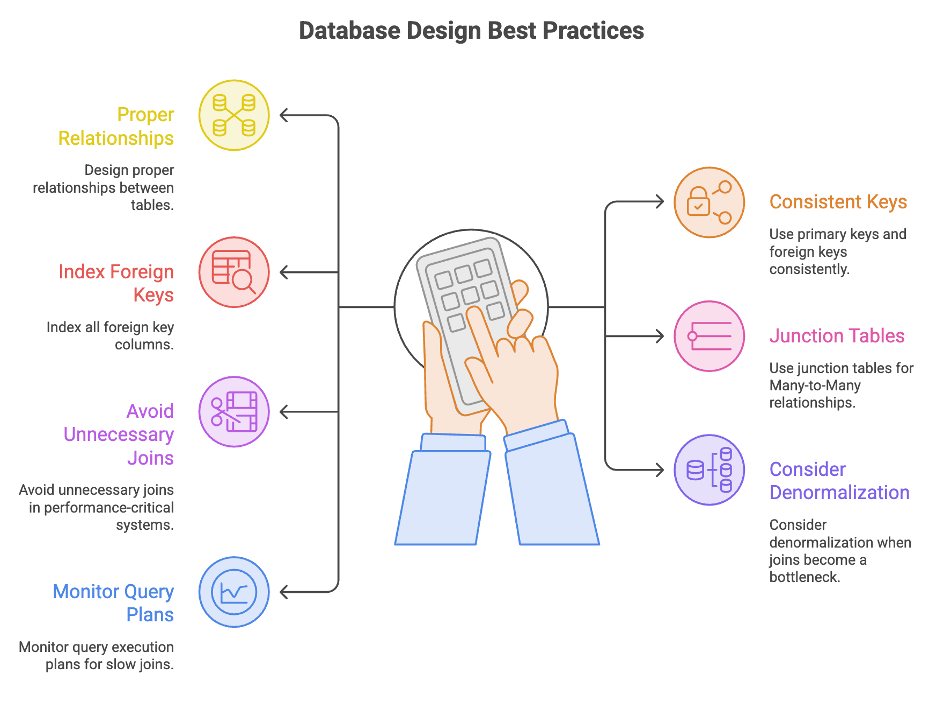
Proper indexing is essential for fast join performance.
-
Excessive joins can become expensive in large-scale systems, where denormalization may be used.
-
Understanding joins is fundamental for database design, backend development, and system design interviews.
Written By: Muskan Garg
How is this guide?
Last updated on