
Implementing Features with Spec-Driven Development
Write a feature spec with acceptance criteria and scope, build an /implement-spec skill that refuses specs without criteria, and implement task filtering from the spec.
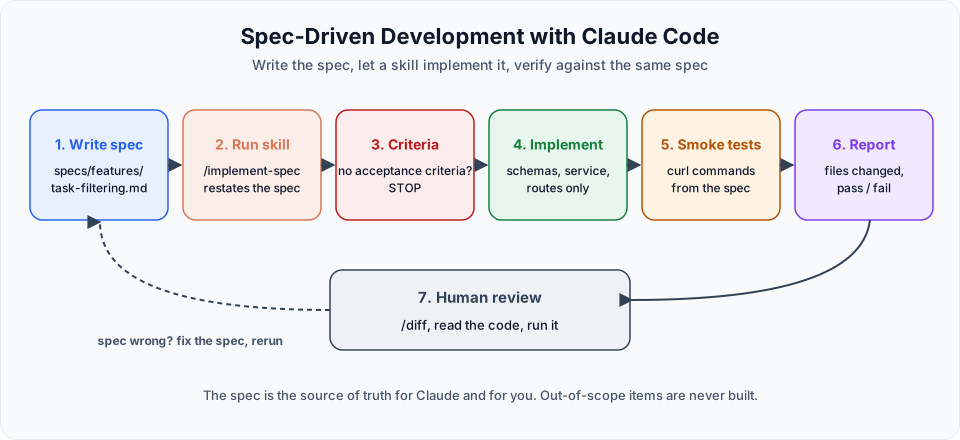
We now combine everything: a spec file that describes a feature, and a skill that implements any spec it is given.
Part 1: Write the spec
Create a folder for feature specs and a file for our first feature:
specs/features/task-filtering.md# Feature: Task filtering on GET /api/tasks
## What it does
Adds query parameter support to GET /api/tasks so the frontend can
request a filtered subset of tasks instead of always getting all of them.
## Why we need it
As the project grows, returning every task on every page load will
become slow. Filtering by state and assigned_role lets the frontend
fetch only what it needs for the current view.
## Behaviour
### GET /api/tasks (no params): unchanged
Returns all tasks. Existing behaviour preserved exactly.
### GET /api/tasks?state=editing
Returns tasks where state == "editing".
Invalid state values → 400 with body: {"detail": "invalid state: <value>"}
### GET /api/tasks?assigned_role=Editor
Returns tasks where assigned_role == "Editor".
Invalid role values → 400 with body: {"detail": "invalid role: <value>"}
### GET /api/tasks?state=editing&assigned_role=Editor
Both filters applied (AND).
## Acceptance criteria
- Existing GET /api/tasks calls continue to return all tasks
- Invalid state or role returns 400 with a clear error message
- Valid filter returns 200 with the filtered list (empty array allowed)
- Per-task response shape is unchanged, the frontend code does NOT change
- The route remains in backend/app/api/v1/tasks.py
## Out of scope
- Pagination (separate spec)
- Sorting (separate spec)
- Date range filtering (separate spec)
## Smoke test (all must pass)
curl -s "http://localhost:8000/api/tasks?state=editing" | python -m json.tool
curl -s "http://localhost:8000/api/tasks?state=invalid" -w "\nStatus: %{http_code}\n"
curl -s "http://localhost:8000/api/tasks?assigned_role=Editor" | python -m json.tool
curl -s "http://localhost:8000/api/tasks" | python -m json.tool # must still return allAnatomy of a good spec
| Section | Why it matters |
|---|---|
| What it does | One clear statement of the feature |
| Why we need it | Context, so decisions in the code make sense |
| Behaviour | Exact inputs, outputs and error responses, including status codes and error bodies |
| Acceptance criteria | A checklist that defines "done". These become your tests |
| Out of scope | What must not be built, even if it looks like a natural addition |
| Smoke test | Concrete commands to verify the result |
A spec is only as good as its details
In the video, the spec used video_editor as the role value, but our model's roles are Admin, Content, Editor and Uploader. The implementation was correct, but the smoke test failed because the spec was wrong. Claude flagged it for human review. The version above uses the real value, Editor. Before you write a spec, check the actual enum values in your models.
Part 2: Build the /implement-spec skill
.claude/skills/implement-spec/SKILL.md---
description: Implement a feature described in a markdown spec file anywhere under specs. Reads the spec, builds the feature end-to-end across schemas, service, and routes, and runs the smoke tests from the spec. Use when the user provides a spec file path.
argument-hint: <path-to-spec-file>
disable-model-invocation: true
allowed-tools: Read Write Edit Grep Glob Bash(curl *) Bash(uv run *) Bash(git diff *)
---
You are implementing a feature from a markdown specification.
## Input
The spec file path is in $ARGUMENTS.
Example: /implement-spec specs/features/task-filtering.md
## Required reading
1. The spec file at $ARGUMENTS. This is your source of truth
2. CLAUDE.md: project conventions
3. backend/app/api/v1/tasks.py: existing endpoint patterns
4. backend/app/services/task_service.py: service patterns
5. backend/app/schemas/task.py: schema patterns
6. specs/api-contract.md: the overall contract
## Steps
### 1. Restate the spec
Print one line: "Implementing <feature-name>: <one-line behaviour>"
This proves you read the spec, not guessed it.
### 2. Extract acceptance criteria
List them. These are your tests.
If the spec has no acceptance criteria section, STOP. Tell the user
the spec needs acceptance criteria before implementation.
### 3. Extract out-of-scope items
List them. These are NOT part of this work.
Do not implement them even if they seem like natural additions.
### 4. Implement
Touch only the files needed. Match existing patterns in each file.
Pydantic v2. Async SQLAlchemy. snake_case Python. CLAUDE.md conventions.
### 5. Run smoke tests from the spec
Skip this step by default. Only run if the user explicitly passes `--test` in the arguments.
If `--test` is passed: execute every curl command in the spec's smoke test section,
show actual output for each, and PASS or FAIL each against the spec's expectation.
### 6. Report
Output markdown with:
- Spec implemented (path)
- Files modified (one line each)
- Smoke test results (pass/fail per test, with actual output)
- Acceptance criteria items that could NOT be tested via curl, flagged for human review
## Hard rules
- The spec is the source of truth. Do not add behaviour the spec does not describe.
- Do not modify the spec file itself.
- Do not modify frontend/ unless the spec explicitly says so.
- If the spec is ambiguous, STOP and ask the user to clarify and update the spec.The design choices that make this skill reliable
| Rule | Effect |
|---|---|
| Restate the spec in one line | Proves Claude read the actual file instead of guessing from the name |
| No acceptance criteria, no implementation | Forces you to define "done" before any code is written. This is what good engineers do |
| List out-of-scope items | Stops scope creep: no surprise pagination or sorting |
Smoke tests only with --test | Lets you implement quickly, then test when the backend is running |
| Do not modify the spec | The spec stays a stable contract. If it is wrong, you fix it |
| Stop when ambiguous | Claude asks instead of inventing behaviour |
Part 3: Implement the feature
Start a fresh session, switch to Sonnet, and run:
/implement-spec specs/features/task-filtering.md --testClaude:
- Prints a one-line restatement, something like
Implementing task filtering: optional state and assigned_role filters on GET /api/tasks - Lists the five acceptance criteria and the three out-of-scope items
- Adds optional
stateandassigned_rolequery parameters to the route, and the filtering logic to the service - Starts the backend if it is not running, and runs each smoke test
- Reports the files changed, pass or fail for each test, and anything that needs a human
Then review the diff yourself:
/diffYou should see the new query parameters in api/v1/tasks.py and a filtered query in task_service.py, and nothing else.
Vibe prompt vs spec
| Vibe prompt | Spec | |
|---|---|---|
| Example | "add filtering to tasks" | specs/features/task-filtering.md |
| Inputs and outputs | Claude guesses | Written down, with exact error bodies |
| Done means | "looks like it works" | Every acceptance criterion passes |
| Scope | Whatever Claude thinks is natural | Out-of-scope list is explicit |
| Reusable | No, lost in chat history | Yes, committed to git and reviewed |
| Testing | Ad hoc | Smoke tests are part of the spec |
A spec template you can copy
# Feature: <short name>

## What it does
One or two sentences.

## Why we need it
The problem it solves.

## Behaviour
### <request or action>
Exact inputs, outputs, status codes and error bodies.

## Acceptance criteria
- Testable statement 1
- Testable statement 2

## Out of scope
- Thing we are deliberately not building (separate spec)

## Smoke test (all must pass)
curl ...
The workflow from now on
For every new feature:
- Write the spec in
specs/features/, with acceptance criteria and out-of-scope items - Run
/implement-spec <path> --test - Review the report and the diff
- If something is wrong in the spec, fix the spec and run it again
- Commit, merge, move on
You write the what. Claude writes the how. You verify both. That is spec-driven development.
Try It Yourself
Before moving to the next section, practise what you learned:
- Create the
/telusko-statusskill with the opening---on line 1, and fix any permission error withallowed-tools. - Use
/scaffold-endpointto addGET /api/tasks/by-role/{role}and check that it follows the existing patterns. - Write a small spec of your own (for example "sort tasks by created date") using the template, then run
/implement-specon it. - Remove the Acceptance criteria section from your spec and confirm the skill refuses to implement it.
Official references
- Extend Claude with skills
- Pass arguments to skills
- Best practices for Claude Code
- FastAPI: query parameters
Written By: Shramik Masti
How is this guide?
Last updated on
Endpoint Scaffolding Skill and Writing Specs
Build a /scaffold-endpoint skill with arguments, tool restrictions and hard rules, use it to add a new endpoint, and see why the next step is writing specs.
JWT Security Flow
Why the role dropdown is fake security, how JWT authentication works using a simple wristband analogy, and the role-based access rules we will enforce on the server.