
Functional and Non-Functional requirements
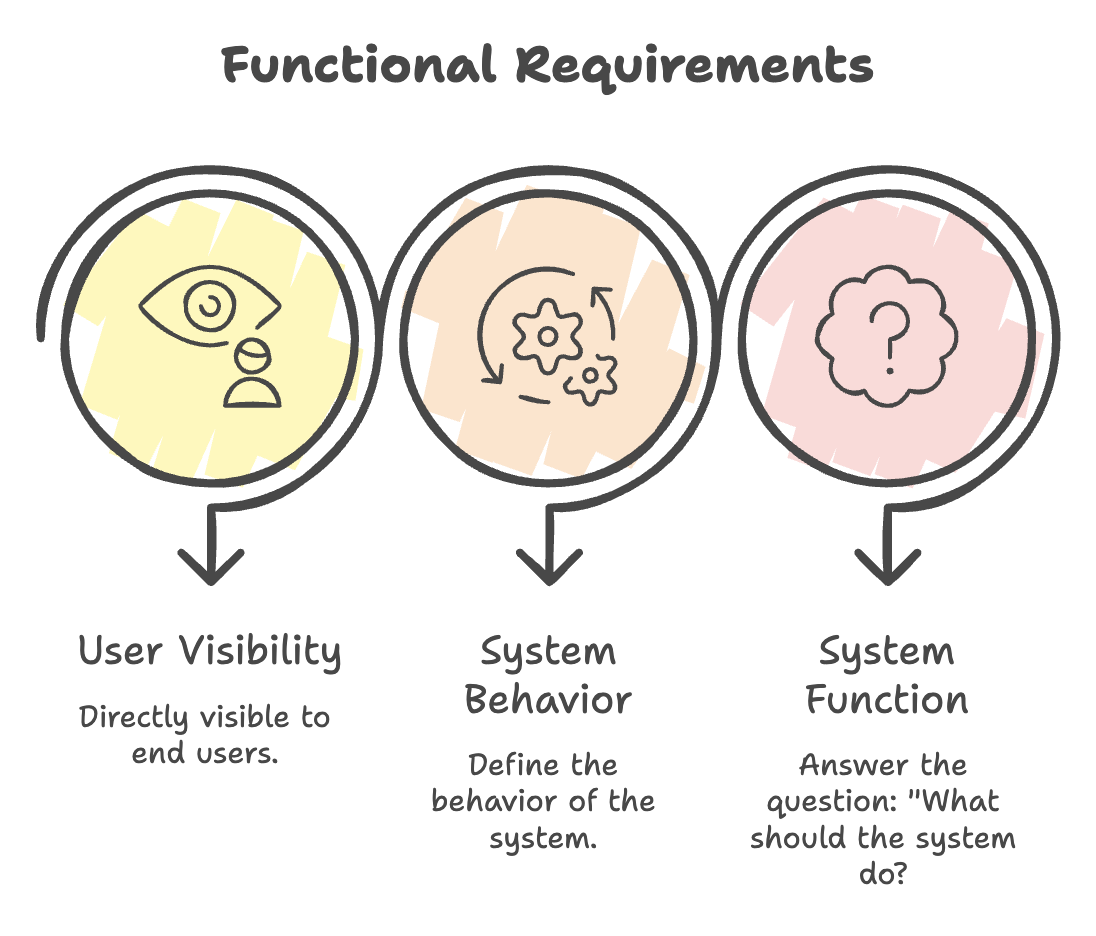
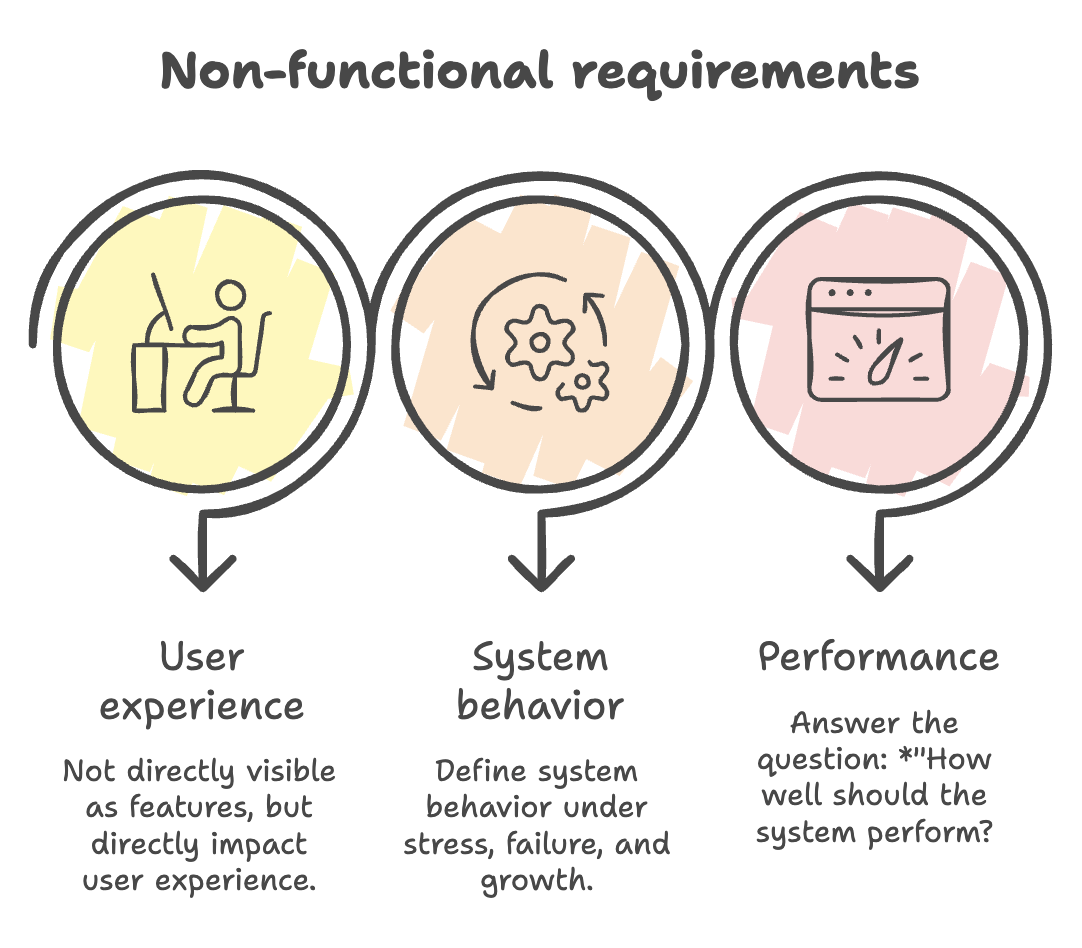
Every system is built around two fundamental types of requirements:
- Functional Requirements - Define what the system does (features)
- Non-Functional Requirements - Define how well the system performs (quality attributes)
Both are equally critical. A system that has all features but crashes under load is just as unusable as a system that performs well but lacks essential functionality.
Functional Requirements
Functional requirements describe the specific features and capabilities an application must provide. They define what actions users can perform and what the system should do in response.
Example - E-Commerce Application
| # | Functional Requirement |
|---|---|
| 1 | User can register an account |
| 2 | User can login |
| 3 | User can browse products |
| 4 | User can search for products |
| 5 | User can filter products |
| 6 | User can add products to cart |
| 7 | User can apply coupon codes |
| 8 | User can place an order |
| 9 | User can make a payment |
| 10 | User can track the order |
Every feature that a user interacts with in an application is a functional requirement.
Why Functional Requirements are Important?
They help developers understand:
- what to build,
- which APIs are needed,
- what database operations are required,
- and how users will interact with the system.
Non-Functional Requirements
Non-functional requirements define how the application performs under various conditions. They specify the quality attributes, constraints, and benchmarks that the system must meet.
Example - E-Commerce Application
| # | Non-Functional Requirement |
|---|---|
| 1 | Should handle 1 million concurrent users |
| 2 | Response time < 200ms |
| 3 | 99.9% availability |
| 4 | Data must be encrypted |
| 5 | Scalable up to 10x traffic |
| 6 | System must be fault-tolerant |
Key Non-Functional Attributes in System Design
1. Scalability
The system's ability to handle increasing load without degradation.
- Vertical Scaling - Upgrading existing server resources (CPU, RAM, storage)
- Horizontal Scaling - Adding more server instances to distribute load
2. Availability
The percentage of time the system remains operational and accessible.
- Measured through SLA (Service Level Agreement) and SLO (Service Level Objective)
- Expressed as uptime percentage (e.g., 99.9% = ~8.7 hours downtime/year)
| Availability | Downtime per Year |
|---|---|
| 99% | ~3.65 days |
| 99.9% | ~8.76 hours |
| 99.99% | ~52.6 minutes |
| 99.999% | ~5.26 minutes |
3. Reliability
Ensures no data loss, the system consistently produces correct results and preserves data integrity even during failures.
4. Performance (Latency)
How fast the system responds to user requests. Measured using percentile-based metrics:
| Metric | Meaning |
|---|---|
| P90 | 90% of requests complete within this time |
| P95 | 95% of requests complete within this time |
| P99 | 99% of requests complete within this time |
P99 captures the worst-case experience for the majority of users and is critical for identifying tail latency issues.
5. Security
Protecting the system and its data from unauthorized access and breaches.
| Aspect | Purpose |
|---|---|
| Authentication | Verify who the user is (e.g., login credentials) |
| Authorization | Verify what the user is allowed to do (e.g., role-based access) |
| Encryption | Protect data in transit and at rest from interception |
6. Maintainability
How easily the system can be modified, updated, and extended over time.
- Achieved through code modularity - clean separation of concerns
- Well-structured code reduces bugs and simplifies onboarding of new developers
7. Observability
The ability to monitor and understand the internal state of a system from its external outputs.
- Monitoring - Real-time tracking of system health and metrics
- Logging - Recording events, errors, and transactions for debugging and auditing
Functional vs Non-Functional
| Functional Requirements | Non-Functional Requirements |
|---|---|
| Define what the system does | Define how the system performs |
| Feature-oriented | Quality-oriented |
| User actions and business logic | Performance and operational behavior |
| Visible to users | Mostly internal/system-level |
| Example: Add to cart | Example: Response time < 200ms |
Summary
- Functional requirements define the core features and business operations of a system, such as login, payments, messaging, search, and ordering.
- Non-functional requirements define the system’s quality attributes, including scalability, performance, security, availability, reliability, and maintainability.
- A successful system must balance both functionality and performance to deliver a reliable and efficient user experience.
- Non-functional requirements are critical for building scalable and production-ready systems capable of handling real-world traffic and operational challenges.
- Understanding and clearly defining both requirement types is the foundation of effective System Design and scalable software architecture.
Written By: Muskan Garg
How is this guide?
Last updated on