
Data Intensive and Compute Intensive Applications
Applications can be broadly classified into two categories based on where the primary bottleneck lies, data movement or computation. Understanding this distinction is crucial for making the right architectural decisions.
What is Latency?
Latency is the time taken by a system to respond to a request.
It represents:
- response delay,
- waiting time,
- or processing delay
Example
When a user clicks:
- “Open Instagram Feed”
- “Play YouTube Video”
- “Send WhatsApp Message”
the time taken before the response appears is called latency.
Data-Intensive Applications
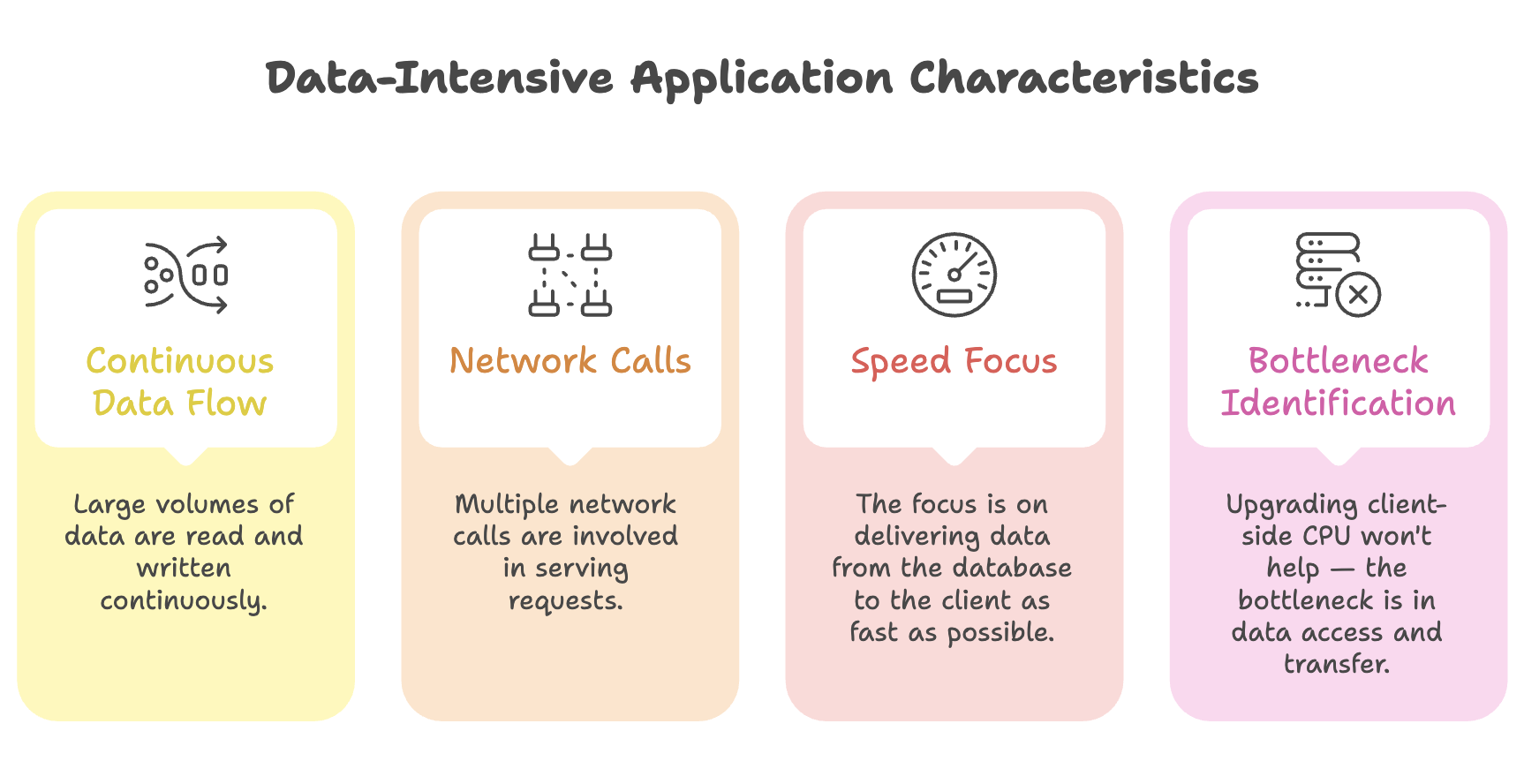
Data-intensive applications are systems where:
The major challenge is handling large amounts of data efficiently.
The focus is on:
- storing data,
- retrieving data,
- transferring data,
- updating data,
- synchronizing data,
- and serving data quickly to users.
Common Examples
| Application | Why It's Data-Intensive |
|---|---|
| Instagram Feed | Millions of posts served to millions of users simultaneously |
| WhatsApp Messages | Constant read/write of messages across devices |
| Banking Transactions | High volume of transactional reads and writes |
| Analytics Dashboard | Aggregating and displaying large datasets in real time |
| Log Processing System | Ingesting, storing, and querying massive log files |
Common Performance Issues
- Slow database response - Queries take too long to return results
- Bulky network calls - Large amounts of data travel across networks that need optimization
- Low server configuration - Server hardware not capable of serving data at required speed
Key Concerns
- How fast can we read the data?
- How safely are we going to store the data?
- How many users can access it simultaneously?
- What if a server dies?
- What if a network call breaks?
Solutions & Techniques
| Technique | Purpose |
|---|---|
| Caching | Store frequently accessed data closer to the user for faster reads |
| Sharding | Split data across multiple databases to distribute load |
| Replication | Maintain copies of data across servers for fault tolerance |
| Consistency Models | Ensure data accuracy across distributed systems |
| Database Optimization | Indexing, query tuning, and choosing the right database type |
Compute-Intensive Applications
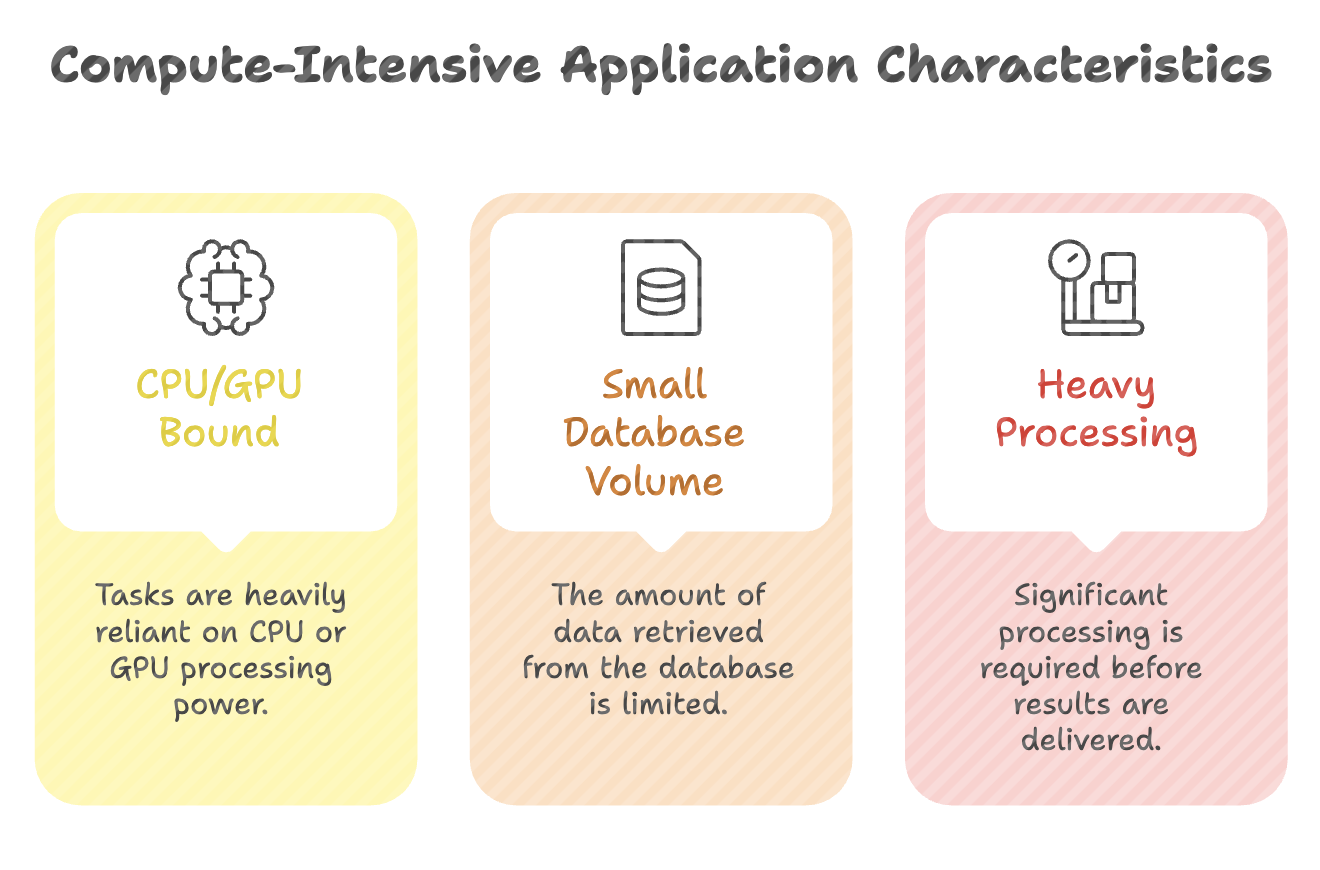
In compute-intensive applications, the primary bottleneck is processing power (CPU/GPU). The amount of data fetched from the database may be small, but the computation required to process, transform, or generate output from that data is heavy.
Common Examples
| Application | Why It's Compute-Intensive |
|---|---|
| Image Processing | Pixel-level transformations, filters, resizing |
| Video Rendering | Frame-by-frame encoding and decoding |
| ML Model Training | Iterative mathematical computations over large parameter spaces |
| Simulations | Physics, weather, or financial modeling |
| Cryptography | Complex encryption/decryption algorithms |
Key Concerns
- How fast can we compute?
- Can we parallelize the work across multiple cores or machines?
- How can we reduce computational complexity?
- Can we use GPU instead of CPU for better throughput?
Data-Intensive vs Compute-Intensive
| Aspect | Data-Intensive | Compute-Intensive |
|---|---|---|
| Bottleneck | Data movement & storage | Processing power |
| Focus | Fast data retrieval & delivery | Fast computation |
| Hardware concern | Disk I/O, Network, Memory | CPU / GPU |
| Data volume | Very high | Relatively low |
| Processing complexity | Low to moderate | Very high |
| Solutions | Caching, sharding, replication | Parallelism, GPU acceleration, algorithm optimization |
Modern Applications Use Both Types
Most modern applications are a combination of:
- data-intensive behavior,
- and compute-intensive behavior.
Example: YouTube
Data-Intensive Serving videos:
- storage,
- streaming,
- retrieval,
- delivery.
Compute-Intensive Recommendation engine:
- AI models,
- analytics,
- personalization algorithms.
Example: Instagram
Data-Intensive
- Feed loading
- Messages
- Media delivery
Compute-Intensive
- Image filters
- AI recommendations
- Face detection
Simple Rule of Thumb
If time is lost in data movement → Data-Intensive Application
If time is lost in computation → Compute-Intensive Application
Summary
-
Modern applications rely on both efficient data management and high-performance computation to deliver scalable and responsive systems.
-
Data-intensive applications primarily focus on fast data storage, retrieval, consistency, and network-efficient data movement.
-
Compute-intensive applications focus on heavy processing tasks that require optimized CPU/GPU utilization and parallel computation.
-
Most large-scale systems combine both approaches, where different features may be either data-bound or compute-bound.
-
Identifying whether the bottleneck lies in data movement or data processing is essential for selecting the right architecture, scaling strategy, and optimization techniques.
Written By: Muskan Garg
How is this guide?
Last updated on