
If Condition
Conditional statements allow a program to make decisions based on conditions.
Python uses if, elif, and else to control which block of code executes depending on whether an expression evaluates to True or False.
Why Do We Need Conditions?
The CPU (Central Processing Unit) is the brain of every computer. It consists of three major units:
| Unit | Full Form | Function |
|---|---|---|
| CU | Control Unit | Manages instruction flow and controls operations |
| ALU | Arithmetic Logic Unit | Performs mathematical and logical decisions |
| MU | Memory Unit | Stores variables, instructions, and data |
The ALU has two sub-units:
-
AU (Arithmetic Unit): Handles addition, subtraction, etc.
-
LU (Logic Unit): Evaluates conditions like
- Is the number even?
- Is A > B?
- Is the condition True or False?
The Logic Unit enables decision-making, and that is exactly what Python’s if statement uses.
The if Statement
The if statement allows Python to execute a block of code only when the condition is True.
Syntax
if condition:
    statements
Key Rules:
- Python does not use
{ }like C/C++. - Code blocks are defined using indentation (4 spaces recommended).
- If the condition is False, the block is skipped.
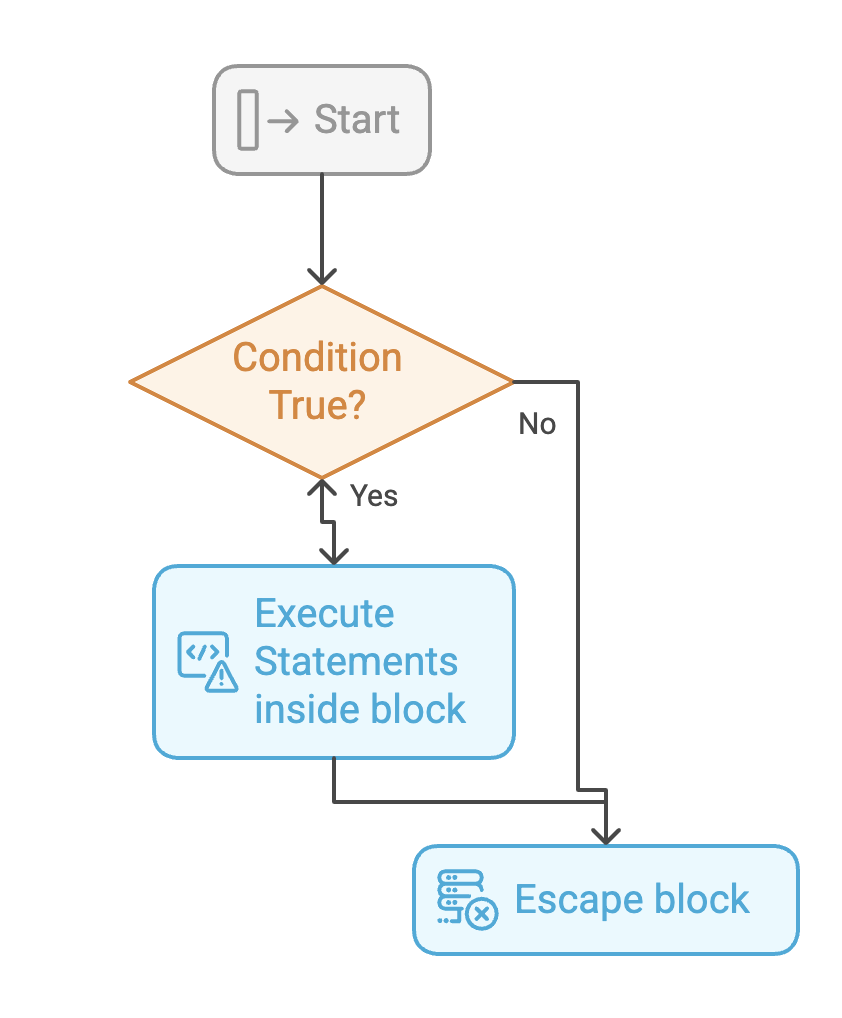
Example:
if True:
    print("I'm right")
Output:
I'm rightExample (False condition):
if False:
    print("I'm right")
print("Bye")
Output:
ByeUnderstanding Indentation in Python
Indentation is mandatory in Python and determines which statements belong to a block.
Example 1 (Both inside the block):
if True:
    print("Even")
    print("Bye")
Output:
Even
Bye
Example 2 (Only first line is inside the block):
if True:
    print("Even")
print("Bye")
Output:
Even
Bye
Example 3 (Condition False):
if False:
    print("Even")
print("Bye")
Output:
ByeMaking Decisions Using Conditions
Conditions evaluate to True or False, allowing programs to behave dynamically.
Example: Check if a number is even or odd.
num = int(input("Enter a number: "))

if num % 2 == 0:
    print("Even")

if num % 2 == 1:
    print("Odd")

print("Bye")
How it works:
%is the modulus operator → gives remainder- Even number →
num % 2 == 0 - Odd number →
num % 2 == 1
Usage of the if Statement
The if statement is used whenever a program must choose between different actions.
Common uses include:
-
Validating user input
if age >= 18: print("Eligible to vote") -
Performing calculations based on conditions
if marks >= 40: print("Pass") -
Executing code only when a condition is met
if is_logged_in: show_dashboard() -
Checking for errors or special cases
if filename == "": print("Filename cannot be empty") -
Making decisions in games, apps, and automation scripts
if health <= 0:
    print("Game Over")
In short, any situation that requires decision-making uses if statements.
Summary
- The
ifstatement is used to execute code only when a condition is True. - Python determines code blocks using indentation, not curly braces.
- The Logic Unit (LU) of the CPU performs logical checks that help programs make decisions.
- Conditions like
num % 2 == 0return True/False, controlling program flow. - Using
if, Python can perform intelligent decisions such as checking even/odd, validating input, comparing values, etc.
Written By: Muskan Garg
How is this guide?
Last updated on