
Nested If
Nested if in Python
In Python, nested if statements allow you to place one decision-making block inside another.
This is useful when you need to check multiple related conditions before deciding what action to take.
A nested if executes only when the outer if condition is True.
Inside it, you can write another if, elif, or else to perform secondary checks.
Why Do We Use Nested if?
Nested if statements are helpful when:
- You need to make a decision only after another condition is satisfied.
- Conditions are dependent on each other.
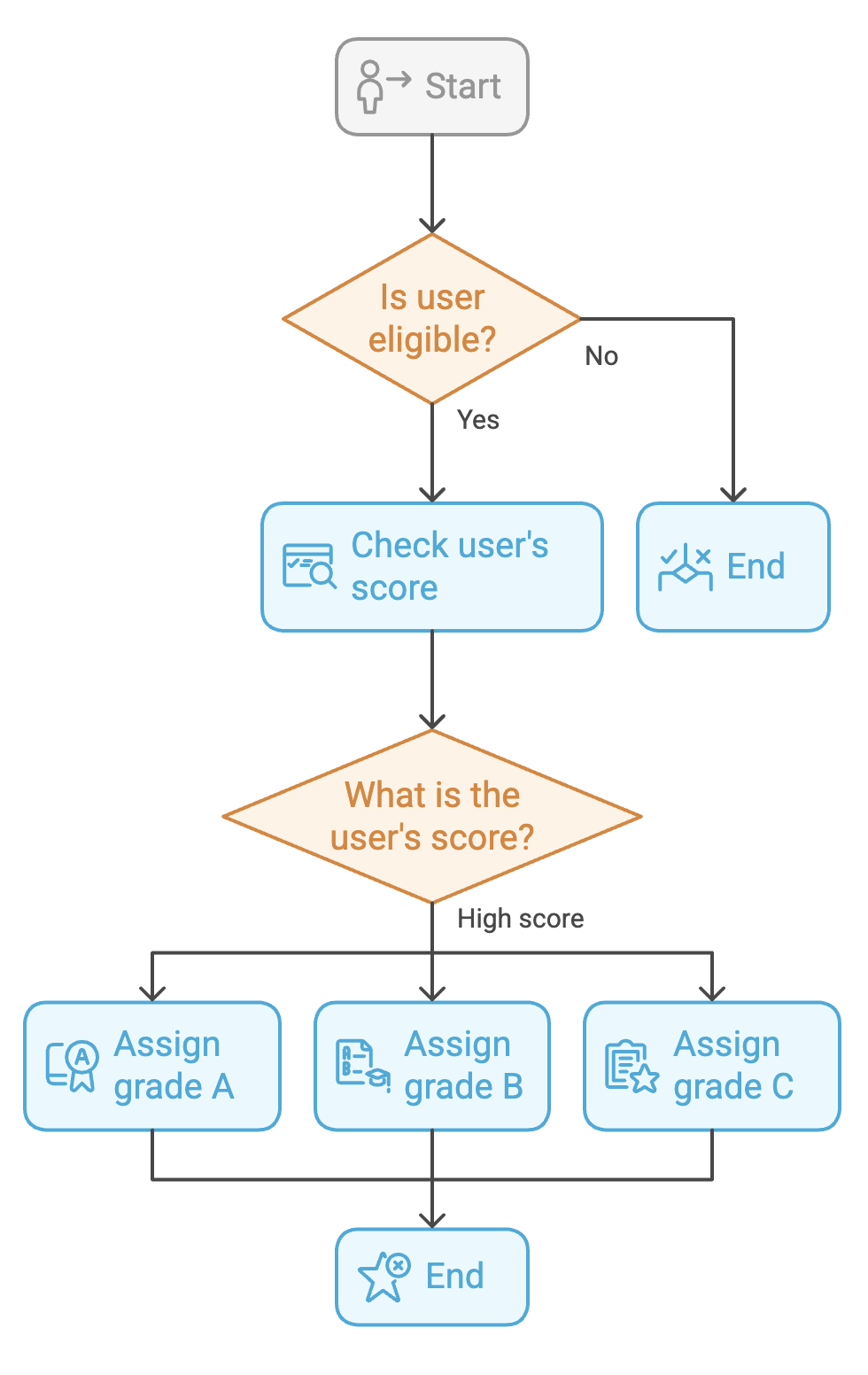
- The logic is tiered, such as:
- If user is eligible
- Then check the user's score
- Then decide the grade
- Then check the user's score
- If user is eligible
This structure keeps your logic clean, readable, and organized.
Syntax of Nested if
if condition1:
    # Outer block
    if condition2:
        # Inner block
    else:
        # Inner else block
else:
    # Outer else block
Each block is defined using indentation (4 spaces recommended). Indentation visually represents the level of nesting and controls which block executes.
Example: Checking Number and Salary
num = 6
salary = 5

if num % 2 == 0:
    print("Even")                 # Outer if
    if salary > 5:
        print("Great Job")        # Inner if
    else:
        print("Better luck next time")  # Inner else
else:
    print("Odd")                  # Outer else

print("Bye")
Output Cases
Case 1: num = 6, salary = 5
Even
Better luck next time
Bye
Reason:
num % 2 == 0→ Truesalary > 5→ False → inner else runs
Case 2: num = 6, salary = 7
Even
Great Job
Bye
Reason:
- Outer condition is True
- Inner condition is also True → prints "Great Job"
Case 3: num = 5
Odd
Bye
Reason:
- Outer condition is False → inner block is completely skipped
- Only the outer
elseexecutes
Key Points to Remember
- A nested
ifexecutes only when the outerifis True. - Proper indentation is needed, Python determines scope based on spaces.
- Helps structure multi-level decision making.
- Inner conditions are checked only when needed, improving clarity and efficiency.
Summary
Nested if statements allow Python programs to make layered decisions, where one condition depends on another. They help handle complex logic cleanly by placing one decision block inside another, ensuring that secondary checks run only when primary conditions are met.
Written By: Muskan Garg
How is this guide?
Last updated on