
Operator Precedence
1. Introduction
In Java, an expression can contain many operators at the same time.
For example:
int result = 10 + 5 * 2 - 3;How does Java decide:
- Which operator to evaluate first?
- In which direction to evaluate when operators have the same precedence?
This is controlled by:
- Operator precedence → decides which operator goes first
- Associativity → decides the direction (left-to-right or right-to-left) for operators of the same precedence
Understanding operator precedence is important to:
- Predict the output of expressions
- Avoid unexpected results
- Write clear and maintainable code (often with parentheses)
2. What Is Operator Precedence?
Operator precedence is a set of rules that decide which operator is evaluated first when multiple operators appear in a single expression.
Example:
int result = 10 + 5 * 2;Here:
*has higher precedence than+- So
5 * 2is evaluated first →10 - Then
10 + 10→20
If you want 10 + 5 to happen first, you must use parentheses:
int result = (10 + 5) * 2; // 30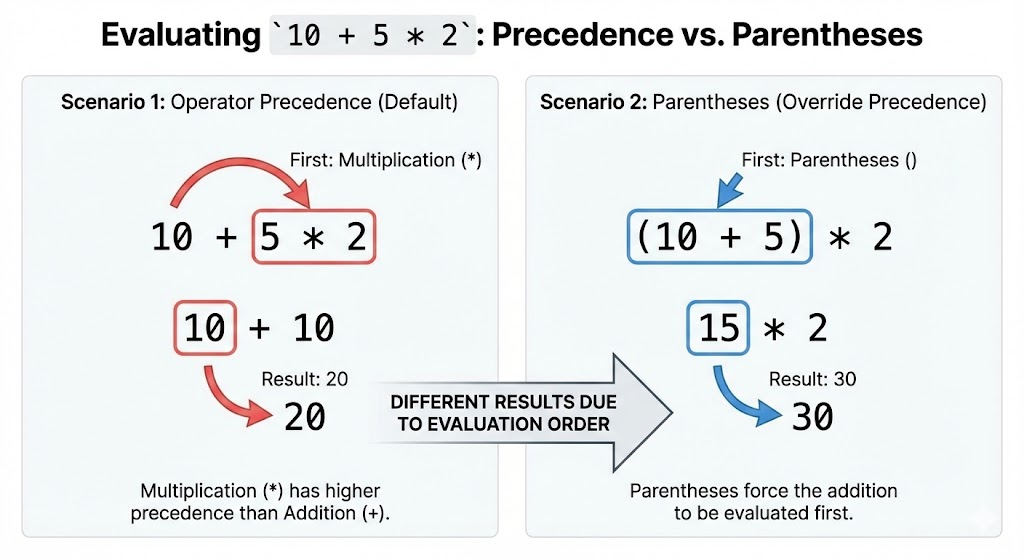
3. What Is Associativity?
Associativity decides the direction of evaluation when operators with the same precedence appear together.
Example:
int x = 10 - 5 - 2;- has left-to-right associativity, so:
- First:
10 - 5 = 5 - Then:
5 - 2 = 3
If it were right-to-left, result would be 10 - (5 - 2) = 7, which is not how Java works for -.
Most operators in Java are left-to-right associative, except:
- Unary operators:
++,--,+,-,~,! - Ternary operator:
?: - Assignment operators:
=,+=,-=, etc.
These have right-to-left associativity.
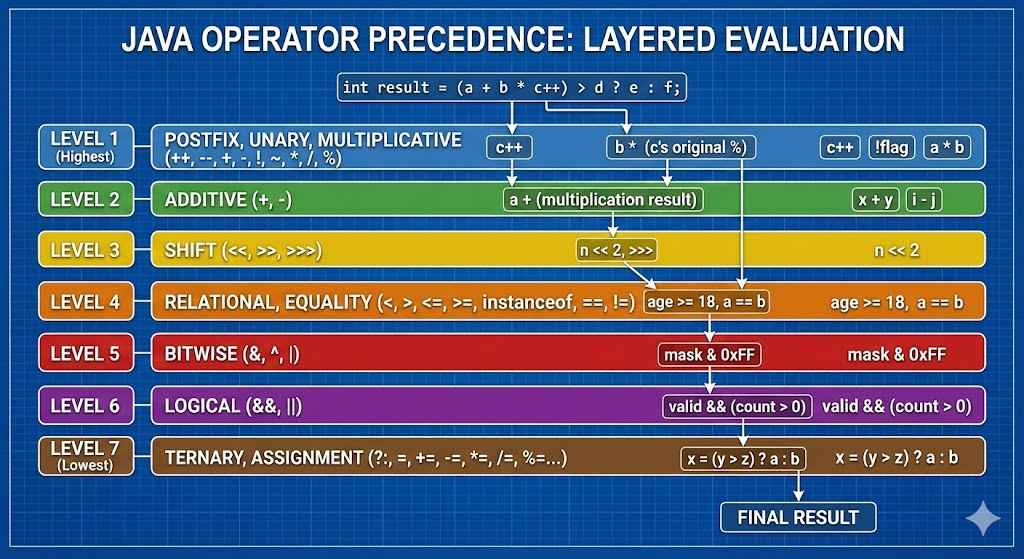
4. Operator Precedence Table (High to Low)
From highest precedence (evaluated first) to lowest (evaluated last):
| Level | Category | Operators | Associativity |
|---|---|---|---|
| 1 | Postfix | expr++, expr-- | Left to right |
| 2 | Unary | ++expr, --expr, +, -, !, ~ | Right to left |
| 3 | Multiplicative | *, /, % | Left to right |
| 4 | Additive | +, - | Left to right |
| 5 | Shift | <<, >>, >>> | Left to right |
| 6 | Relational | <, >, <=, >=, instanceof | Left to right |
| 7 | Equality | ==, != | Left to right |
| 8 | Bitwise AND | & | Left to right |
| 9 | Bitwise XOR | ^ | Left to right |
| 10 | Bitwise OR | | | Left to right |
| 11 | Logical AND | && | Left to right |
| 12 | Logical OR | || | Left to right |
| 13 | Ternary | ?: | Right to left |
| 14 | Assignment | =, +=, -=, *=, /=, %=,&=, ^=, |=, <<=, >>=, >>>= | Right to left |
Use this table as a reference when reading or writing complex expressions.
5. Examples of Precedence in Action
5.1 Arithmetic with Different Operators
int result = 10 + 5 * 2 - 8 / 4;Step-by-step:
- Multiplicative first:
5 * 2 = 10,8 / 4 = 2 - Now expression becomes:
10 + 10 - 2 - Left to right:
10 + 10 = 20 - Then:
20 - 2 = 18
Final result: 18
5.2 With Parentheses
int result = (10 + 5) * (20 - 8) / 4;Steps:
(10 + 5) = 15(20 - 8) = 12- Expression:
15 * 12 / 4 - Multiplicative left to right:
15 * 12 = 180 - Then
180 / 4 = 45
Result: 45
Parentheses always override precedence rules.
6. Precedence with Relational and Logical Operators
int a = 10, b = 20, c = 5;
boolean result = a < b && b > c || c > a;
Order:
-
Relational operators first:
a < b→10 < 20→trueb > c→20 > 5→truec > a→5 > 10→false
-
Now expression:
true && true || false -
&&has higher precedence than||, so:true && true→true
-
Now:
true || false→true
Final result: true
7. Precedence and Assignment
Assignment has the lowest precedence (evaluated near the end), and is right-to-left associative.
Example:
int a, b, c;
a = b = c = 10;
This is evaluated as:
b = c = 10;- First
c = 10→cbecomes 10 - Then
b = c→bbecomes 10 - Then
a = b→abecomes 10
All three variables become 10.
8. Precedence in Ternary Operator
Ternary operator ?: has low precedence but higher than assignment.
int a = 10, b = 20;
int max = (a > b) ? a : b;
Here:
- Relational
>evaluated first - Then ternary
?: - Finally assignment
=
If you write:
int x = 10;
int y = 20;
int result = x > y ? x + 10 : y + 10;
The expressions x + 10 and y + 10 are evaluated based on the condition x > y.
9. Complex Expression Example
Consider:
int a = 5, b = 10, c = 15;
int result = a + b * c > 100 && b < c || a == 5;
Step-by-step:
- Multiplicative:
b * c = 10 * 15 = 150 - Additive:
a + 150 = 5 + 150 = 155 - Relational:
155 > 100→trueAlso:b < c→10 < 15→trueAnd:a == 5→true - Logical AND first:
true && true→true - Logical OR:
true || true→true
Final result: true
10. Best Practices
- Do not rely too heavily on remembering all precedence rules for very complex expressions.
- Use parentheses to make expressions clear and explicit.
- Keep expressions simple and readable.
- When in doubt, break expressions into multiple lines:
int temp = a + b * c;
boolean cond = temp > 100 && b < c;
boolean result = cond || a == 5;
This is easier to read, debug, and maintain.
11. Summary
- Operator precedence decides which operator is evaluated first.
- Associativity decides the direction of evaluation when precedence is the same.
- Most operators are left-to-right associative, but unary, ternary, and assignment are right-to-left.
- Parentheses can always be used to override precedence and improve readability.
- Understanding precedence helps predict and control complex expression behavior in Java.
How is this guide?
Last updated on