
Garbage Collector Types
Garbage Collection (GC) in Java is the automatic process of reclaiming heap memory occupied by objects that are no longer reachable. Unlike manual memory management in C or C++, Java delegates memory cleanup to the JVM, reducing memory leaks, dangling pointers, and segmentation faults.
GC is part of the JVM’s memory management system and plays a critical role in application performance, scalability, and responsiveness.
What is Garbage Collection?
Garbage Collection is the process of:
- Identifying unreachable objects
- Reclaiming memory used by those objects
- Optionally compacting memory to reduce fragmentation
Example:
public class GCExample {
    public static void main(String[] args) {
        User user = new User("Alice");  // Allocated on Heap
        user = null;                    // Now unreachable

        System.gc(); // Suggests GC (not guaranteed)
    }
}
The object becomes eligible for GC once no active reference points to it.
Core GC Concepts
1. Reachability
An object is eligible for GC if it is not reachable from GC Roots.
GC Roots include:
- Local variables on the stack
- Static fields
- Active threads
- JNI references
Example:
public class ReachabilityExample {
    static User staticUser = new User("Bob");

    public static void main(String[] args) {
        User localUser = new User("Alice");
        User temp = new User("Charlie");

        temp = null; // Eligible for GC
    }
}
Only objects reachable from roots are preserved.
2. Generational Hypothesis
The JVM is based on the observation that:
Most objects die young.
To optimize for this, the heap is divided into generations:
Heap Structure:
-
Young Generation
- Eden
- Survivor 0
- Survivor 1
-
Old Generation (Tenured)
Young generation is collected frequently and quickly. Old generation is collected less often.
3. Types of GC Events
Minor GC
- Collects Young Generation
- Fast and frequent
Major GC
- Collects Old Generation
- Slower
Full GC
- Collects entire heap (Young + Old)
- Slowest
- Causes full application pause
4. Stop-The-World (STW)
During certain GC phases, application threads are paused.
Application Running → STW Pause → GC → Resume
Reducing pause time is critical for low-latency systems.
Object Lifecycle in Generational GC
- Objects are created in Eden space.
- When Eden fills, Minor GC runs.
- Surviving objects move to Survivor spaces.
- After surviving multiple cycles, objects are promoted to Old Generation.
Example:
for (int i = 0; i < 1000; i++) {
    User user = new User("User" + i);
}
Most objects die in Eden and never reach Old Generation.
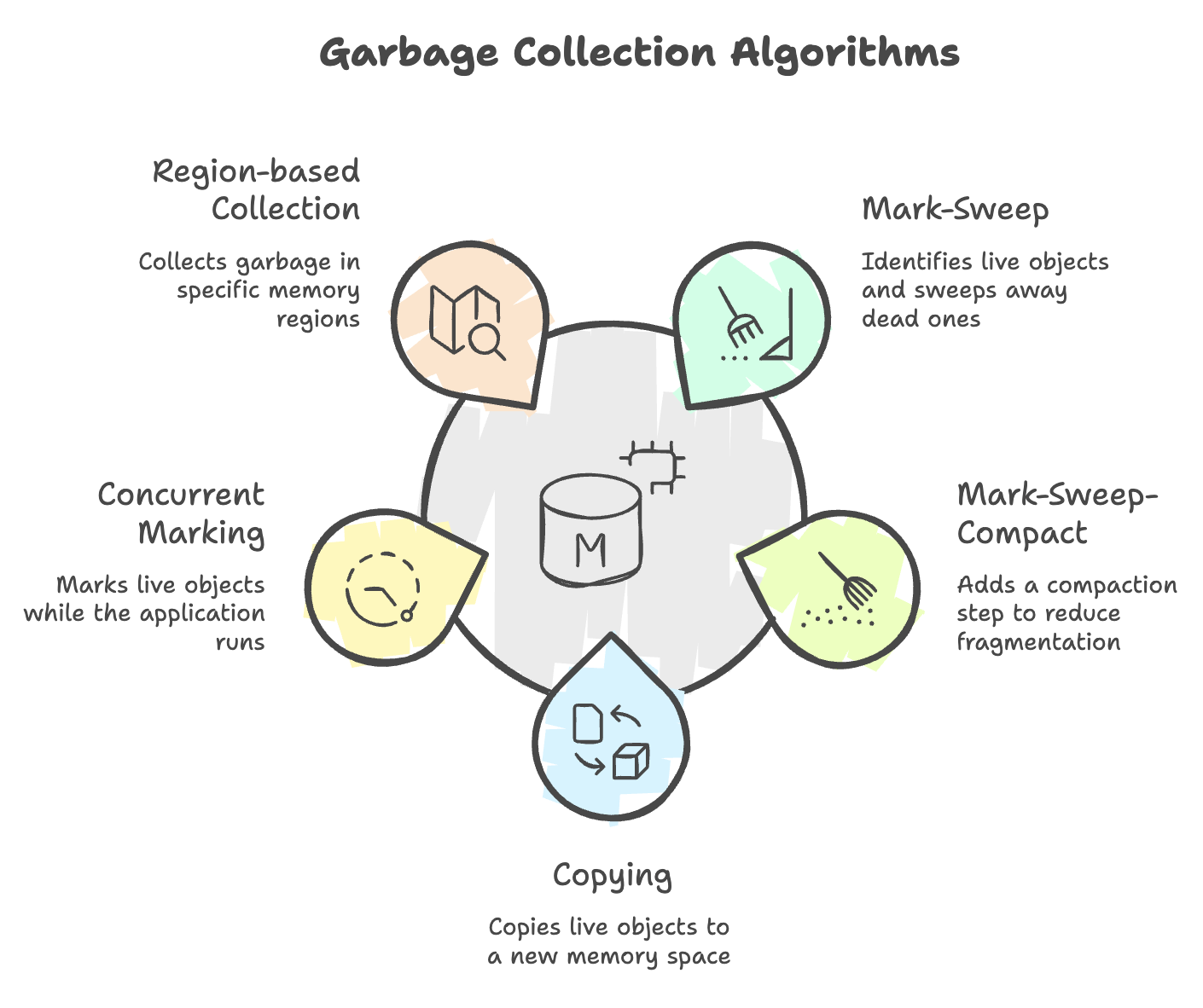
Types of Garbage Collectors in Java
Java provides multiple GC implementations optimized for different goals.
1. Serial GC
Single-threaded collector. Performs all GC work using one thread.
Characteristics:
- Stop-The-World for Young and Old
- Uses Copying (Young) and Mark-Sweep-Compact (Old)
- Minimal overhead
Use Case:
- Small heaps
- Single-core systems
- Client applications
Enable:
java -XX:+UseSerialGC MyAppLimitation: Not suitable for large or latency-sensitive systems.
2. Parallel GC (Throughput Collector)
Multi-threaded version of Serial GC.
Characteristics:
- Stop-The-World
- High throughput
- Uses multiple CPU cores
- Default in Java 8
Use Case:
- Batch processing
- CPU-intensive applications
- Throughput-oriented systems
Enable:
java -XX:+UseParallelGC MyAppStrength: Maximizes overall application work.
Weakness: Long pause times.
3. CMS (Concurrent Mark Sweep) – Deprecated
Designed to reduce pause times.
Characteristics:
- Concurrent marking and sweeping
- Shorter STW pauses
- No compaction (can cause fragmentation)
- Removed in Java 14
Use Case (historical):
- Low-latency web applications
Replaced by G1 GC.
4. G1 GC (Garbage-First)
Default GC in Java 9+.
Divides heap into small regions instead of fixed generations.
Characteristics:
- Predictable pause times
- Concurrent marking
- Region-based collection
- Compacts memory
- Handles large heaps efficiently
Enable:
java -XX:+UseG1GC MyAppSet pause goal:
java -XX:MaxGCPauseMillis=200 MyAppBest for:
- Most production systems
- Large heaps
- Balanced throughput and latency
5. ZGC (Z Garbage Collector)
Ultra-low latency collector introduced in Java 11.
Characteristics:
- Pause times typically < 10ms
- Pause time independent of heap size
- Fully concurrent
- Scales to multi-terabyte heaps
Enable:
java -XX:+UseZGC MyAppBest for:
- Financial systems
- Real-time processing
- Very large heaps
Trade-off: Higher CPU and memory overhead.
6. Shenandoah GC
Low-latency collector similar to ZGC.
Characteristics:
- Concurrent evacuation
- Pause times independent of heap size
- Designed for large heaps
Enable:
java -XX:+UseShenandoahGC MyAppUsed in:
- Large-scale, low-latency systems
7. Epsilon GC
No-op collector.
Characteristics:
- Performs no garbage collection
- Allocates memory until exhausted
Enable:
java -XX:+UseEpsilonGC MyAppUsed for:
- Performance testing
- Short-lived applications
Summary
- Garbage Collection is the core of Java’s automatic memory management, using reachability analysis and generational design to efficiently reclaim unused heap memory.
- Different garbage collectors are optimized for specific goals, such as high throughput (Parallel GC), balanced performance (G1), ultra-low latency (ZGC, Shenandoah), or simplicity for small applications (Serial GC).
- Selecting the appropriate collector depends on application requirements like heap size, latency sensitivity, and workload type.
- A clear understanding of GC behavior, pause times, and heap tuning is essential for designing scalable and high-performance Java applications.
Written By: Muskan Garg
How is this guide?
Last updated on