
Integration Requirements and Flow
The plan for building the backend in small feature branches, the target architecture, and how the frontend, FastAPI and SQLite fit together.
We have done the groundwork. The frontend is ready, our CLAUDE.md describes the project and its rules, and the sub-agents produced two specs: api-contract.md and seed-data.json. Now we connect everything.
We could vibe code the backend in one shot. But the whole point is control: building in small, verifiable steps that we understand and can roll back.
The target architecture
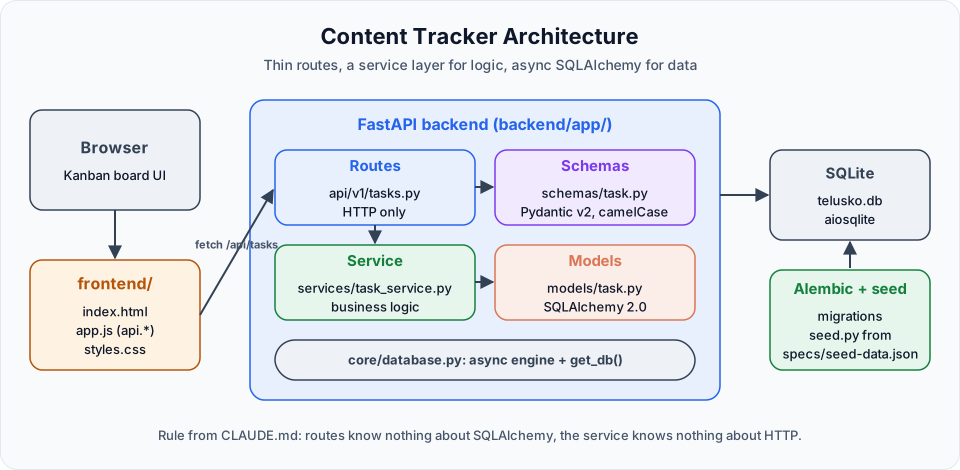
| Layer | Responsibility |
|---|---|
| Browser + frontend | The Kanban UI. Calls api.getTasks(), api.createTask() and so on |
Routes (api/v1/tasks.py) | Receive HTTP requests, validate input, call the service, return responses. No database code |
Schemas (schemas/task.py) | Pydantic v2 models for requests and responses, with camelCase on the wire |
Service (services/task_service.py) | Business logic. No HTTP code |
Models (models/task.py) | SQLAlchemy 2.0 table definitions |
| Database | SQLite through the async aiosqlite driver, as decided in the worktree experiment |
| Alembic + seed | Create tables from models, and load the sample data |
The plan: five feature branches
Professional teams never build a whole backend directly on main. main is what gets deployed. Every change happens on a feature branch, is tested, then merged. Once merged, the branch is deleted.
We follow the same discipline with Claude Code:
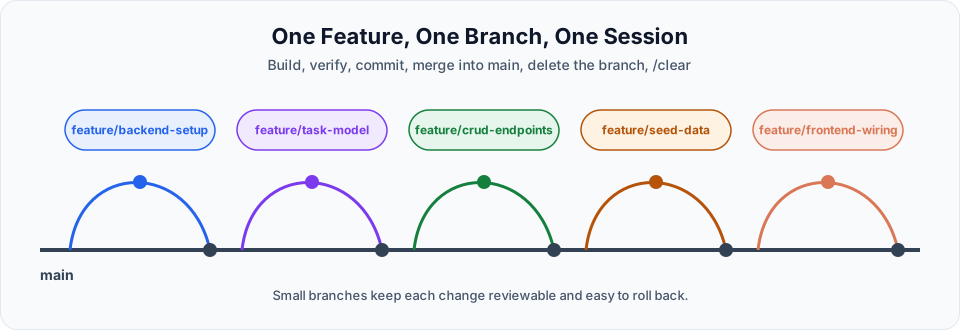
| # | Branch | What we build |
|---|---|---|
| 1 | feature/backend-setup | The skeleton: folder structure, uv project, dependencies. No business code yet |
| 2 | feature/task-model | SQLAlchemy Task model, Pydantic schemas, async database engine, first Alembic migration |
| 3 | feature/crud-endpoints | The four API endpoints and the service layer. Test with Swagger |
| 4 | feature/seed-data | An idempotent seed script that loads specs/seed-data.json |
| 5 | feature/frontend-wiring | Replace the failing mockFetch with a real fetch to the backend |
For every branch the loop is the same:
- Create the branch
- Start a fresh session (or
/clear) - Give Claude a precise prompt that points at the specs
- Review the changes with
/diff - Test it
- Commit, merge into
main, delete the branch
Git commands for every branch
You will repeat this cycle five times, so it is worth knowing by heart:
git checkout -b feature/<name>    # 1. start the feature
# ... work with Claude, review with /diff ...
git add .                         # 2. stage
git commit -m "feat: ..."         # 3. commit (or let Claude write the message)
git checkout main                 # 4. go back to main
git merge feature/<name>          # 5. bring the feature in
git branch -d feature/<name>      # 6. delete the merged branch
Inside Claude Code you can run each line with the ! prefix, for example !git status, so it does not go through the model.
Definition of done for each branch
Before you merge a branch, every box should be ticked:
- The prompt referenced the spec files instead of describing things from memory
- You read the full
/diff, not just Claude's summary - The code follows
CLAUDE.md: service layer, schemas and models in their folders, snake_case, type hints - You ran it yourself (Swagger, curl or the browser), not only Claude's own checks
- Nothing outside the feature changed (no surprise edits in
frontend/orspecs/) - The commit message explains what and why
A note on uv
While planning, we realised something was missing: we want uv as the Python package manager, not plain pip. uv is much faster, manages Python versions, and keeps dependencies locked in pyproject.toml and uv.lock.
This should have been in CLAUDE.md from day one. It is never too late. We add it as the very first step of the backend setup.
Lesson learned
Decide your tooling (package manager, Python version, formatter, test runner) before Claude writes the first file, and put it in CLAUDE.md. Changing tools later is always more work.
The request flow we are aiming for
Browser (http://localhost:8080)
   │
   ▼
frontend/app.js  ── api.getTasks() ──►  fetch("http://localhost:8000/api/tasks")
                                              │
                                              ▼
                                FastAPI route  (api/v1/tasks.py)
                                              │
                                              ▼
                                Service layer  (services/task_service.py)
                                              │
                                              ▼
                                SQLAlchemy  ──►  SQLite (telusko.db)
When this works end to end, clicking Move Forward on a card updates the database, and the board shows the new state after a refresh.
Official references
Written By: Shramik Masti
How is this guide?
Last updated on
Worktrees and Parallel Tasks
Use git worktrees to run separate Claude Code sessions in parallel, compare SQLite and Postgres for our backend, and clean up afterwards.
Preparing Project Context
Pick the right model for implementation, read the context window like a battery indicator, and manage compaction yourself instead of leaving it to chance.