
Faults and Errors
A fault or error occurs when a system fails to perform as expected or deviates from its intended behavior. Faults can affect a system's reliability, availability, performance, and data integrity.
Understanding different types of faults helps architects design resilient systems that can detect, tolerate, and recover from failures effectively.
Why is Understanding Faults Important?
Modern distributed systems consist of multiple servers, networks, databases, and applications. Failures can occur at any layer, making it essential to identify potential fault sources and implement appropriate mitigation strategies.
By understanding fault categories, organizations can:
- Improve system reliability.
- Reduce downtime.
- Increase fault tolerance.
- Minimize data loss.
- Design effective recovery mechanisms.
Categories of Faults
Hardware Failures
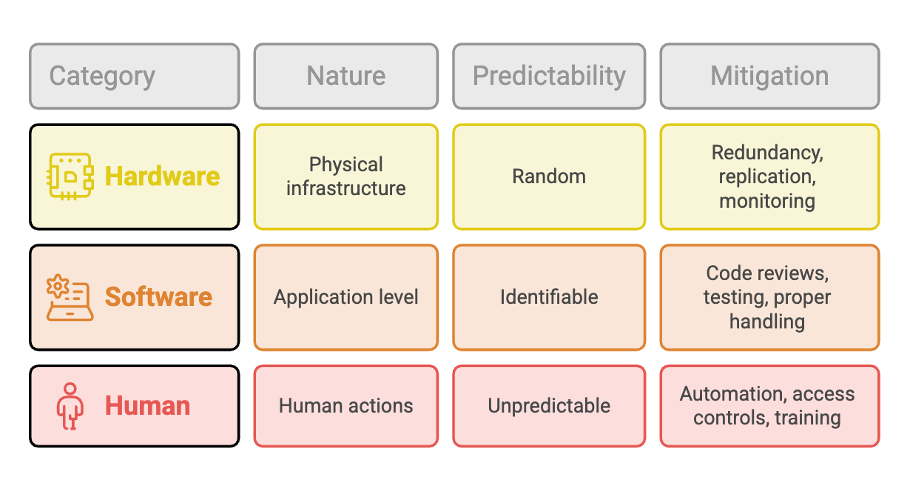
Hardware Failures are failures related to the physical infrastructure of a system. These failures are often random, unpredictable, and difficult to prevent completely.
Since hardware components naturally wear out over time, distributed systems rely on redundancy and replication to maintain availability.
Common Causes
- Disk full
- Disk crash
- Server failure
- Network cable damage
- Power supply failure
- Hardware overheating
- Database hardware compromise
Characteristics
- Random and difficult to predict.
- May cause complete service outages.
- Can lead to data loss if redundancy is absent.
- Usually require hardware replacement or failover.
Mitigation Strategies
- Data replication
- Server redundancy
- RAID storage
- Backup power supplies (UPS)
- Regular hardware monitoring
- Automatic failover mechanisms
Software Failures
Software Failures occur due to issues in application code, system configuration, deployment, or software logic.
Unlike hardware failures, software failures are generally preventable and fixable through proper engineering practices.
Common Causes
- Poor or unoptimized code
- Unhandled exceptions
- Missing edge-case handling
- Configuration errors
- Deployment failures
- Merge conflicts
- Performance bottlenecks
Characteristics
- Usually deterministic and reproducible.
- Can often be identified during testing.
- May affect application functionality or performance.
- Easier to fix compared to hardware failures.
Mitigation Strategies
- Code reviews
- Unit and integration testing
- Proper exception handling
- Continuous Integration / Continuous Deployment (CI/CD)
- Automated testing
- Performance optimization
- Configuration validation
Human Errors
Human Errors are failures caused by incorrect actions or decisions made by users, developers, administrators, or operators.
They are considered one of the most unpredictable sources of system failures.
Common Examples
- Incorrect configuration changes
- Accidental data deletion
- Wrong deployment procedures
- Misconfigured servers
- Incorrect database updates
- Permission mismanagement
Characteristics
- Difficult to predict.
- Cannot be eliminated.
- May affect multiple system components.
- Often caused by manual processes.
Mitigation Strategies
- Automation of repetitive tasks
- Role-based access control (RBAC)
- Standard operating procedures
- Change approval processes
- User-friendly interfaces
- Continuous training and documentation
Best Practices for Fault Tolerance
- Design systems with redundancy and replication.
- Continuously monitor infrastructure and applications.
- Automate deployments and operational tasks.
- Implement comprehensive testing before production releases.
- Use robust backup and disaster recovery strategies.
- Restrict access using role-based permissions.
- Document operational procedures and provide regular training.
Summary
- A fault or error occurs when a system deviates from its expected behavior, potentially affecting reliability, availability, and performance.
- Hardware Failures involve physical infrastructure issues such as server crashes, disk failures, power outages, or network problems and are commonly mitigated using redundancy, replication, monitoring, and failover mechanisms.
- Software Failures result from defects in code, application logic, configuration, or deployment and can be significantly reduced through code reviews, testing, exception handling, and CI/CD practices.
- Human Errors are caused by incorrect actions or decisions and are best minimized through automation, access controls, standardized processes, clear documentation, and continuous training.
- Building resilient distributed systems requires anticipating all three categories of faults and implementing appropriate prevention, detection, and recovery mechanisms.
Written By: Muskan Garg
How is this guide?
Last updated on