
Need of Stream API
The Stream API was introduced in Java 8 to address the limitations of traditional collection processing. It provides a functional programming approach to process collections declaratively, making code more readable, maintainable, and enabling parallel processing with minimal effort.
Problems with Traditional Approach
1. Verbose and Imperative Code
// Problem: Find all even numbers and multiply by 2

List<Integer> numbers = Arrays.asList(1,2,3,4,5,6,7,8,9,10);
List<Integer> result = new ArrayList<>();

for (Integer num : numbers) {
    if (num % 2 == 0) {
        result.add(num * 2);
    }
}

System.out.println(result);
Issues:
- Too many lines for simple operation
- Manual loop management
- Explicit intermediate collection creation
- Mixing "what to do" with "how to do it"
- Error-prone (mutable state)
2. No Built-in Parallel Processing
// Problem: Process large collection in parallel

List<Integer> largeList = new ArrayList<>();
for (int i = 0; i < 1_000_000; i++) {
    largeList.add(i);
}

// Traditional approach - Sequential processing only
long sum = 0;
for (Integer num : largeList) {
    sum += num * 2;  // Process sequentially
}

// To parallelize, you need:
// - Manual thread management
// - Thread pool creation
// - Synchronization handling
// - Result aggregation
// - Complex error handling
Issues:
- No easy way to parallelize
- Manual thread management required
- Complex synchronization logic
- Risk of concurrency bugs
3. Limited Reusability
// Problem: Apply multiple operations on same collection

List<Person> people = getPeople();

// Operation 1: Get names of adults
List<String> adultNames = new ArrayList<>();
for (Person person : people) {
    if (person.getAge() >= 18) {
        adultNames.add(person.getName());
    }
}

// Operation 2: Sort adults by name
List<Person> sortedAdults = new ArrayList<>();
for (Person person : people) {
    if (person.getAge() >= 18) {
        sortedAdults.add(person);
    }
}
Collections.sort(sortedAdults, Comparator.comparing(Person::getName));
Issues:
- Repeated filtering logic
- Can't compose operations
- Multiple iterations over same data
- Code duplication
4. External Iteration (Pull Model)
// Traditional for-each loop
for (String item : collection) {
    // You control the iteration
    process(item);
}
Issues:
- Explicit loop control
- Can't easily optimize
- Sequential by nature
- Tight coupling with the collection structure
5. No Lazy Evaluation
// Problem: Find first even number > 100

List<Integer> numbers = generateMillionNumbers();

// Traditional approach - processes entire list
Integer result = null;
for (Integer num : numbers) {
    if (num % 2 == 0 && num > 100) {
        result = num;
        break;  // Manual short-circuit
    }
}
Issues:
- No automatic short-circuiting
- Manual break statements needed
- Can't defer computation
- Processes unnecessary elements
What is Stream API?
A sequence of elements supporting sequential and parallel aggregate operations with a functional programming approach.
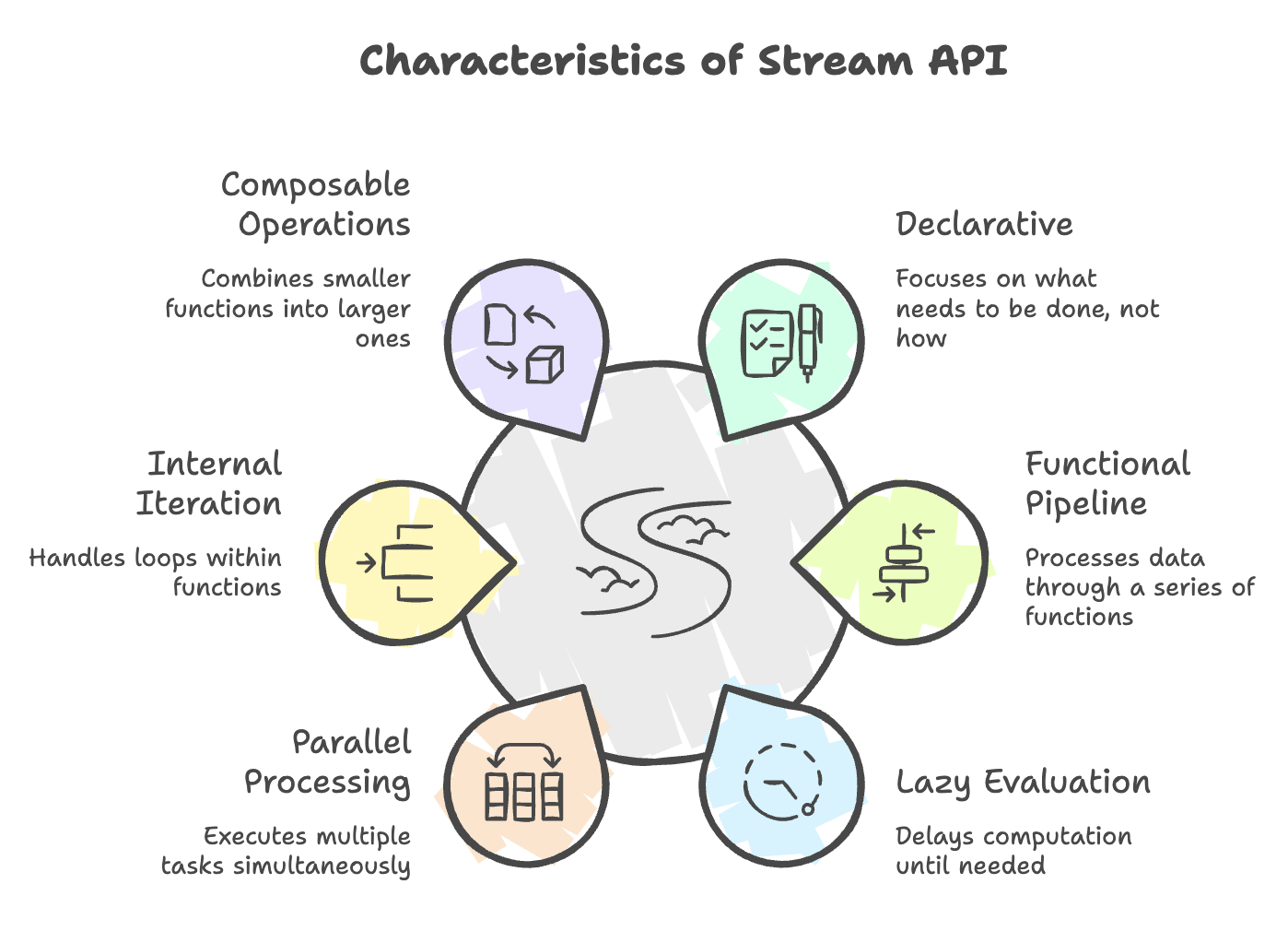
How Stream API Solves These Problems
1. Concise and Declarative Code
// Stream API approach
List<Integer> numbers = Arrays.asList(1, 2, 3, 4, 5, 6, 7, 8, 9, 10);

List<Integer> result = numbers.stream()           // Create stream
    .filter(n -> n % 2 == 0)                      // Filter even numbers
    .map(n -> n * 2)                               // Transform
    .collect(Collectors.toList());                 // Collect results

System.out.println(result);  // [4, 8, 12, 16, 20]
Benefits:
- Readable: Reads like English ("filter even, map to double")
- Concise: 3 lines vs 6+ lines
- Declarative: Describes what, not how
- No mutable state: No intermediate variables
2. Built-in Parallel Processing
// Stream API with parallel processing
List<Integer> largeList = IntStream.range(0, 1_000_000)
    .boxed()
    .collect(Collectors.toList());

// Parallel processing - just add parallel()
long sum = largeList.parallelStream()
    .mapToLong(n -> n * 2)
    .sum();

// That's it! No manual:
// - Thread pool management
// - Task splitting
// - Result aggregation
// - Synchronization
Benefits:
- One word change:
.stream()→.parallelStream() - Automatic work distribution: Fork-Join framework
- Thread-safe: Handled internally
- Performance gain: Utilizes multiple cores
3. Composable and Reusable Operations
List<Person> people = getPeople();

// Reusable predicate
Predicate<Person> isAdult = p -> p.getAge() >= 18;

// Operation 1: Get names of adults
List<String> adultNames = people.stream()
    .filter(isAdult)
    .map(Person::getName)
    .collect(Collectors.toList());

// Operation 2: Sort adults by name
List<Person> sortedAdults = people.stream()
    .filter(isAdult)
    .sorted(Comparator.comparing(Person::getName))
    .collect(Collectors.toList());
Benefits:
- Reusable predicates: Define once, use multiple times
- Composable: Chain operations fluently
- Single pass: Stream optimization reduces iterations
- No duplication: DRY principle
4. Internal Iteration (Push Model)
// Stream API - Internal iteration
collection.stream()
    .forEach(item -> process(item));

// Or with method reference
collection.stream()
    .forEach(this::process);
Benefits:
- Framework controls iteration: Optimized internally
- Can be parallelized: Framework decides
- Abstraction: Don't care about "how"
- Flexibility: Framework can optimize
5. Lazy Evaluation and Short-Circuiting
// Stream API - Automatic lazy evaluation
List<Integer> numbers = generateMillionNumbers();

Integer result = numbers.stream()
    .filter(n -> n % 2 == 0)      // Intermediate (lazy)
    .filter(n -> n > 100)          // Intermediate (lazy)
    .findFirst()                   // Terminal (triggers execution)
    .orElse(null);

// Only processes until first match is found!
// No need for manual break statement
Benefits:
- Automatic short-circuit: Stops when answer found
- Lazy evaluation: Operations deferred until needed
- Efficient: Doesn't process unnecessary elements
- Optimized: Framework optimizes pipeline
Common Operations Supported by Streams
Streams provide powerful operations for typical data processing tasks.
Filtering elements based on conditions:
List<Employee> senior = employees.stream()
    .filter(e -> e.getExperience() > 5)
    .collect(Collectors.toList());
Transforming data:
List<String> names = employees.stream()
    .map(Employee::getName)
    .collect(Collectors.toList());
Aggregating values:
double avgSalary = employees.stream()
    .mapToDouble(Employee::getSalary)
    .average()
    .orElse(0.0);
Grouping data:
Map<String, List<Employee>> byDept =
    employees.stream()
        .collect(Collectors.groupingBy(Employee::getDepartment));
Searching elements:
Optional<Employee> emp =
    employees.stream()
        .filter(e -> e.getId() == 101)
        .findFirst();
Advantages of Using Stream API
- The Stream API improves code quality, readability, and performance when working with collections.
- It reduces verbosity by removing explicit loops and intermediate mutable variables, resulting in concise declarative code.
- It supports functional programming practices with minimal side effects, improving reliability and maintainability.
- Built-in parallel processing enables efficient handling of large datasets using multi-core processors.
- Lazy evaluation ensures that computations are performed only when needed, avoiding unnecessary processing.
- Composable operations and internal iteration allow flexible processing pipelines while enabling framework-level optimizations.
When to Use Stream API?
Stream API is best suited for processing collections using operations such as filtering, transformation, aggregation, and building complex data processing pipelines. It is particularly useful for large datasets and situations where code readability, conciseness, and maintainability are important. However, it may not be appropriate when elements need to be modified in place, when index-based access is required, or when a simple loop provides a clearer and more efficient solution.
Summary
- The Stream API was introduced to address the limitations of traditional collection processing with a declarative and functional approach.
- It supports internal iteration, lazy evaluation, and functional composition for efficient data processing.
- Built-in parallelism allows scalable performance on multi-core systems.
- It enables concise, readable, and maintainable code for complex data operations.
- Understanding its purpose helps developers choose the most appropriate approach in modern Java applications.
Written By: Muskan Garg
How is this guide?
Last updated on