
Records
Record classes are introduced as a preview feature in Java 14 and standardized in Java 16, a revolutionary addition to the Java language designed to reduce boilerplate code when creating simple data carrier classes drastically. They represent a shift toward more concise and expressive code, making Java competitive with modern languages while maintaining type safety and clarity.
The Problem: Verbose Data Classes
Before records, creating a simple class to hold data required an enormous amount of boilerplate code. Let's examine a typical scenario:
Traditional Approach (Before Records)
Suppose we want to create an Alien class to represent an alien with an id and name:
public class Alien {
    // 1. Private final fields for immutability
    private final int id;
    private final String name;

    // 2. Parameterized constructor
    public Alien(int id, String name) {
        this.id = id;
        this.name = name;
    }

    // 3. Getter methods
    public int getId() {
        return id;
    }

    public String getName() {
        return name;
    }

    // 4. Override equals() for value-based comparison
    @Override
    public boolean equals(Object o) {
        if (this == o) return true;
        if (o == null || getClass() != o.getClass()) return false;
        Alien alien = (Alien) o;
        return id == alien.id && Objects.equals(name, alien.name);
    }

    // 5. Override hashCode() for proper hashing
    @Override
    public int hashCode() {
        return Objects.hash(id, name);
    }

    // 6. Override toString() for readable output
    @Override
    public String toString() {
        return "Alien{id=" + id + ", name='" + name + "'}";
    }
}
Approximately 40-50 lines of code for a simple two-field data class!
Problems with Traditional Approach
- Excessive Boilerplate: Most code is mechanical and repetitive
- Error-Prone: Easy to make mistakes in
equals(),hashCode(), or forget to update them when adding fields - Maintenance Burden: Adding a new field requires updating multiple methods
- Reduced Readability: The actual purpose (holding data) is obscured by implementation details
- Time-Consuming: Writing and testing all this code takes significant development time
The Solution: Record Classes
Record classes solve all these problems with a single line of code:
public record Alien(int id, String name) {
}
That's it! This single declaration automatically provides:
- Private final fields
- Canonical constructor
- Getter methods
equals()methodhashCode()methodtoString()method
Understanding Record
Basic Syntax
[access-modifier] record RecordName(ComponentType1 component1, ComponentType2 component2, ...) {
    // Optional: custom methods, constructors, static members
}
Components
The parameters in parentheses are called components. They define:
- The record's state (fields)
- The parameters for the canonical constructor
- The accessor methods that will be generated
record Person(String firstName, String lastName, int age) {
}

// Components: firstName, lastName, age
// This automatically creates:
// - private final String firstName;
// - private final String lastName;
// - private final int age;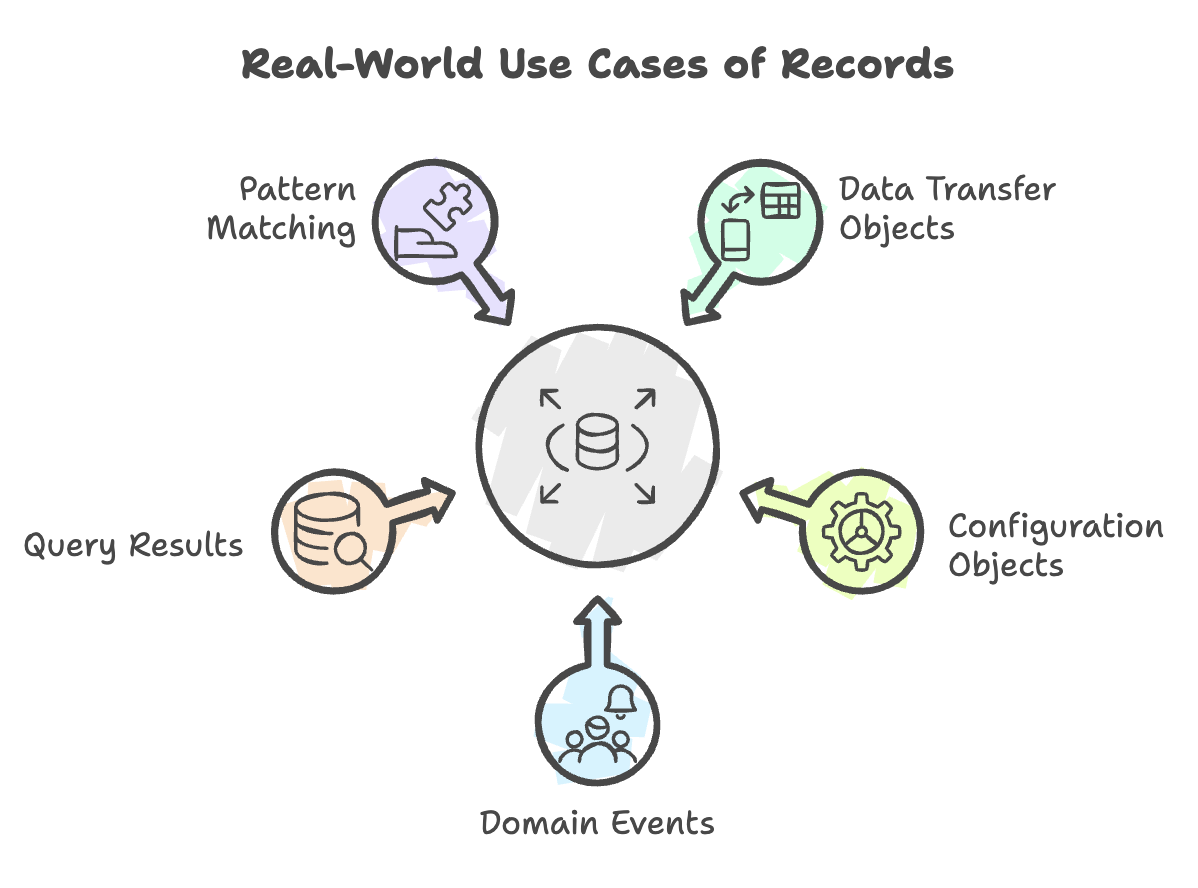
Automatic Features of Records
1. Canonical Constructor
A public constructor with all components that cannot leave any component uninitialized.
record Alien(int id, String name) {
}

// Usage
Alien alien = new Alien(1, "Naveen");
System.out.println(alien); // Output: Alien[id=1, name=Naveen]
Behind the scenes, this is equivalent to:
public Alien(int id, String name) {
    this.id = id;
    this.name = name;
}
2. Accessor Methods (Getters)
Record classes provide accessor methods, but with a different naming convention than traditional Java Beans:
record Alien(int id, String name) {
}

Alien alien = new Alien(1, "Naveen");

// Traditional class would use: alien.getId(), alien.getName()
// Record uses component names directly:
int alienId = alien.id();       // NOT getId()
String alienName = alien.name(); // NOT getName()

System.out.println("ID: " + alien.id());     // Output: ID: 1
System.out.println("Name: " + alien.name()); // Output: Name: Naveen
Why this naming? It's more concise and aligns with the record's component-based design.
3. toString() Method
Records automatically generate a meaningful toString() implementation:
record Alien(int id, String name) {
}

Alien alien = new Alien(1, "Naveen");
System.out.println(alien);
// Output: Alien[id=1, name=Naveen]Format: RecordName[component1=value1, component2=value2, ...]
This is extremely useful for debugging and logging.
4. equals() Method
Records implement value-based equality, comparing all components:
record Alien(int id, String name) {
}

Alien alien1 = new Alien(1, "Naveen");
Alien alien2 = new Alien(1, "Naveen");
Alien alien3 = new Alien(2, "Rahul");

System.out.println(alien1.equals(alien2)); // true (same values)
System.out.println(alien1.equals(alien3)); // false (different id)
System.out.println(alien1 == alien2); // false (different objects)Important: Two records are equal if:
- They are of the same record type
- All their corresponding components are equal
5. hashCode() Method
A proper hashCode() implementation is automatically provided, consistent with equals():
record Alien(int id, String name) {
}

Alien alien1 = new Alien(1, "Naveen");
Alien alien2 = new Alien(1, "Naveen");

System.out.println(alien1.hashCode());
System.out.println(alien2.hashCode());
// Both will have the same hash code

// Records work correctly in hash-based collections
Set<Alien> aliens = new HashSet<>();
aliens.add(alien1);
aliens.add(alien2);
System.out.println(aliens.size()); // Output: 1 (treated as duplicates)
Immutability of Record
Records are Immutable by Default
All fields in a record are implicitly private and final, meaning:
- Fields cannot be modified after construction
- No setter methods are generated
- Records are inherently thread-safe
record Alien(int id, String name) {
}

Alien alien = new Alien(1, "Naveen");
// alien.id = 2;          // COMPILATION ERROR: Cannot access private field
// No setId() method exists
Why Immutability?
- Thread Safety: Safe to use in multi-threaded environments
- Predictability: Object state cannot change unexpectedly
- Cache-Friendly: Can be safely cached and shared
- Functional Programming: Aligns with functional programming principles
Caution with Mutable Components
While the record reference is immutable, if components contain mutable objects, their internal state can still change:
record Person(String name, List<String> hobbies) {
}

Person person = new Person("Alice", new ArrayList<>(List.of("Reading")));
person.hobbies().add("Gaming"); // This works! List is mutable

System.out.println(person);
// Output: Person[name=Alice, hobbies=[Reading, Gaming]]
Best Practice: Use immutable collections for true immutability:
record Person(String name, List<String> hobbies) {
    // Defensive copy in constructor
    public Person {
        hobbies = List.copyOf(hobbies); // Creates immutable copy
    }
}
Limitations and Restrictions
1. Cannot Extend Classes:
Records implicitly extend java.lang.Record, so they cannot extend any other class.
Reason: Java doesn't support multiple inheritance, and records already extend Record.
2. Cannot Define Additional Instance Fields
All instance states must be declared as components in the record header because records are designed to be pure data carriers with explicit state.
3. Records are Implicitly Final
You cannot extend a record, they are implicitly final, preventing inheritance.
4. Can Implement Interfaces
Records can implement interfaces, making them flexible for polymorphism.
Summary
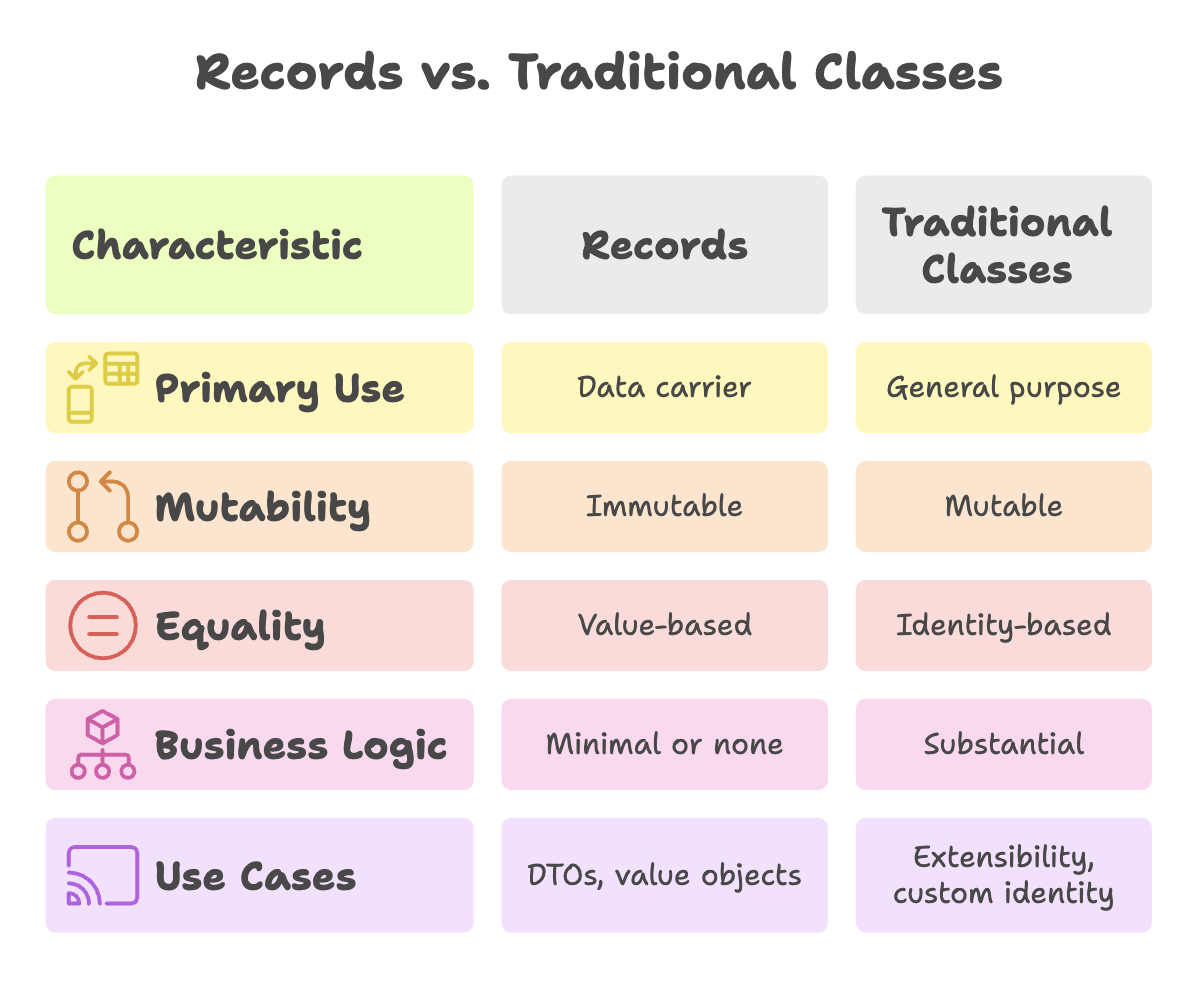
- Provide a concise way to define immutable data carriers with minimal boilerplate.
- Automatically generate constructor, accessors,
equals(),hashCode(), andtoString(). - Promote immutability, improving thread safety and predictability.
- Clearly express intent as value-based data objects (ideal for DTOs and value objects).
- Support validation and custom behavior while maintaining type safety and clarity.
Written By: Muskan Garg
How is this guide?
Last updated on