
LinkedHashMap
Introduction
LinkedHashMap is a hash table and linked list implementation of the Map interface in Java. It extends HashMap and maintains a predictable iteration order of elements.
Unlike HashMap, which does not guarantee any order of keys, LinkedHashMap maintains the order of elements using a doubly-linked list that runs through all entries in the map.
This allows it to combine:
- Fast lookup using a hash table
- Ordered iteration using a linked list
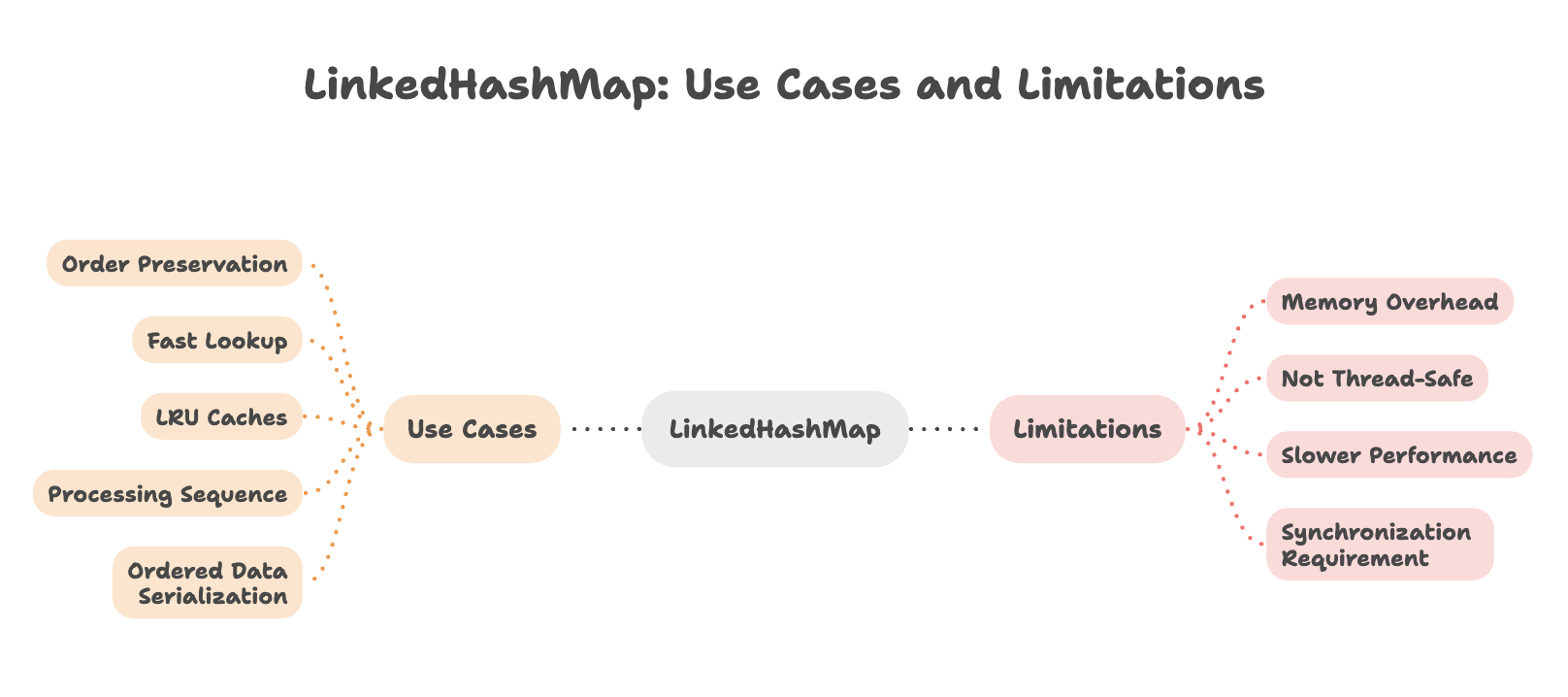
Because of this design, LinkedHashMap is commonly used when both fast access and predictable iteration order are required.
Why LinkedHashMap is Needed?
HashMap does not guarantee any iteration order. When iterating through a HashMap, the order of keys may appear random and can change between executions.
Example:
Map<String, Integer> map = new HashMap<>();

map.put("C", 3);
map.put("A", 1);
map.put("B", 2);

for(String key : map.keySet()){
    System.out.println(key);
}
Possible output:
B
A
C
The order is not predictable.
In applications where the insertion sequence must be preserved, this behavior becomes problematic.
LinkedHashMap solves this issue by maintaining the order of elements.
How LinkedHashMap Works?
LinkedHashMap internally combines two data structures:
- Hash Table (from HashMap) – Provides fast access using hashing.
- Doubly Linked List – Maintains the order of elements.
The hash table ensures O(1) average time complexity for operations such as get() and put(), while the linked list ensures ordered iteration.
Conceptual Structure
Hash Table Buckets

[0] → Entry(A,1)
[1] → Entry(C,3)
[2] → Entry(B,2)
Doubly Linked List:
head → A ⇄ B ⇄ C ← tailThe linked list maintains the order in which entries were inserted or accessed.
Internal Entry Structure
LinkedHashMap uses a special entry class that extends HashMap.Node.
static class Entry<K,V> extends HashMap.Node<K,V> {

    Entry<K,V> before;
    Entry<K,V> after;

}
Each entry contains:
- Key
- Value
- Hash
- Reference to next node (for bucket collisions)
- Reference to previous entry
- Reference to next entry
These additional pointers allow the map to maintain a doubly-linked list of entries.
Head and Tail References
LinkedHashMap keeps references to the first and last elements of the linked list.
transient LinkedHashMap.Entry<K,V> head;
transient LinkedHashMap.Entry<K,V> tail;

final boolean accessOrder;head→ first element in the listtail→ last element in the listaccessOrder→ determines ordering type
Ordering Modes
LinkedHashMap supports two ordering strategies.
1. Insertion Order (Default)
Entries are maintained in the order they were inserted.
Example:
LinkedHashMap<String,Integer> map = new LinkedHashMap<>();

map.put("First",1);
map.put("Second",2);
map.put("Third",3);

for(String key : map.keySet()){
    System.out.println(key);
}
Output:
First
Second
Third
Updating a value does not change the order.
map.put("First",100)The order remains unchanged.
2. Access Order
When accessOrder is set to true, entries are ordered based on the most recent access.
Example:
LinkedHashMap<String,Integer> map =
        new LinkedHashMap<>(16,0.75f,true);

map.put("A",1);
map.put("B",2);
map.put("C",3);

map.get("A");
Now the order becomes:
B → C → AThe accessed element moves to the end of the list.
Operations that affect access order include:
get()put()(when key exists)putIfAbsent()compute()merge()
Operations such as containsKey() do not affect order.
Core Operations
1. put()
The put() operation performs two tasks:
- Inserts the element into the hash table.
- Links the new entry to the end of the doubly-linked list.
Example:
LinkedHashMap<String,Integer> map = new LinkedHashMap<>();

map.put("A",1);
map.put("B",2);
map.put("C",3);
Linked list structure:
head → A ⇄ B ⇄ C ← tail2. get()
The get() method retrieves the value using hash lookup.
map.get("A");Behavior depends on ordering mode:
Insertion order → No change in position Access order → Entry moves to the end of the list
3. remove()
When an element is removed:
- It is removed from the hash table.
- It is also unlinked from the doubly-linked list.
Example:
Before:
A ⇄ B ⇄ C ⇄ D

remove(B)

After:
A ⇄ C ⇄ D
Iteration
Iteration in LinkedHashMap follows the linked list order, which ensures predictable traversal.
Example:
for(Map.Entry<String,Integer> entry : map.entrySet()){
    System.out.println(entry.getKey()+" "+entry.getValue());
}
Output follows insertion order or access order depending on configuration.
Implementing an LRU Cache
LinkedHashMap is commonly used to implement Least Recently Used (LRU) caches.
This is done by:
- Enabling access order
- Overriding
removeEldestEntry()
Example:
class LRUCache<K,V> extends LinkedHashMap<K,V>{

    private int capacity;

    public LRUCache(int capacity){
        super(capacity,0.75f,true);
        this.capacity = capacity;
    }

    protected boolean removeEldestEntry(Map.Entry<K,V> eldest){
        return size() > capacity;
    }
}
Usage:
LRUCache<Integer,String> cache = new LRUCache<>(3);

cache.put(1,"A");
cache.put(2,"B");
cache.put(3,"C");

cache.get(1);

cache.put(4,"D");
The least recently used element is removed automatically.
Performance Characteristics
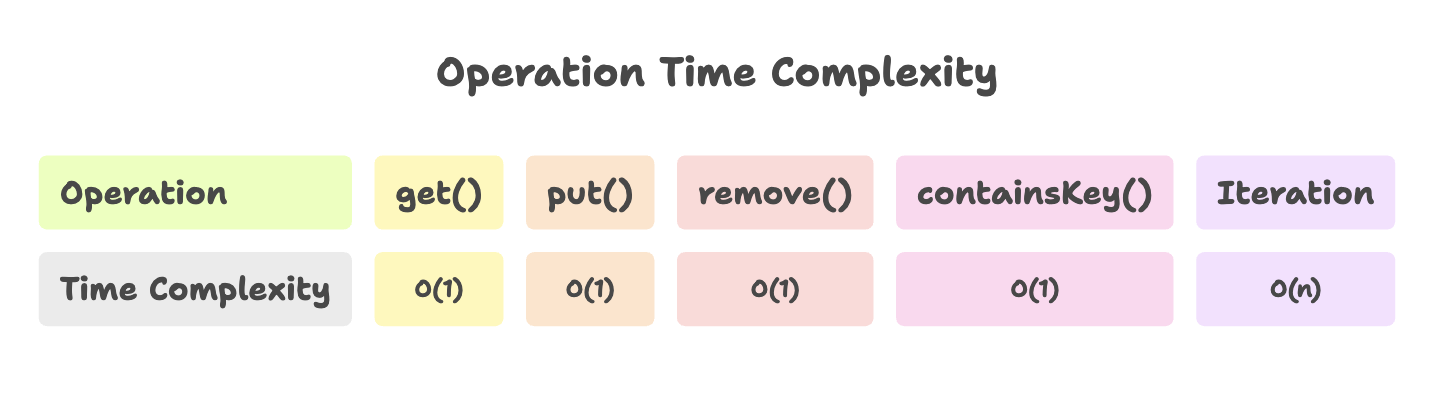
Space complexity is O(n) with additional memory overhead for linked list pointers.
Best Practices
-
Use insertion order when maintaining data sequence.
-
Use access order when implementing LRU cache behavior.
-
Pre-size the map if the expected number of entries is known to reduce resizing overhead.
-
Synchronize the map when used in multi-threaded environments.
Summary
LinkedHashMapis a map implementation that extendsHashMapand maintains a predictable iteration order using an internal doubly-linked list of entries.- It provides two ordering modes: insertion order, which preserves the sequence in which elements are added, and access order, which rearranges elements based on their most recent access.
- The data structure combines the fast lookup performance of a hash table with the ordered traversal capability of a linked list, allowing
get()andput()operations to run in O(1) average time. LinkedHashMapis commonly used in applications that require ordered data processing, such as LRU cache implementations, command history tracking, and ordered configuration management.- Although it offers predictable iteration and efficient lookups, it introduces slightly higher memory overhead compared to
HashMapbecause of the additional linked list references.
Written By: Muskan Garg
How is this guide?
Last updated on