
ConcurrentHashMap
ConcurrentHashMap is a thread-safe implementation of the Map interface designed for high concurrency. Unlike HashMap (not thread-safe) and Hashtable (fully synchronized), ConcurrentHashMap provides:
- Thread safety without locking the entire map
- High performance under concurrent access
- Scalability for multi-threaded applications
- Fail-safe iterators that don't throw
ConcurrentModificationException
The Problem with HashMap and Hashtable
HashMap: Not Thread-Safe
Map<String, Integer> map = new HashMap<>();

// Thread 1
map.put("key1", 1);

// Thread 2
map.put("key2", 2);

// Problem: Race conditions, data corruption, infinite loops during resize!
Issues:
- Race conditions during put/resize
- Data corruption
- Infinite loops (Java 7 resize bug)
- ConcurrentModificationException during iteration
Hashtable: Fully Synchronized (Slow)
Map<String, Integer> map = new Hashtable<>();

// Every method is synchronized
public synchronized V get(Object key) { ... }
public synchronized V put(K key, V value) { ... }
Issues:
- Coarse-grained locking: Entire map locked for every operation
- Poor scalability: Only one thread can access at a time
- Performance bottleneck: All threads wait for lock
Thread 1: get()  ────────┐
Thread 2: put()          │ All wait for global lock
Thread 3: remove()       │
Thread 4: get()  ────────┘
ConcurrentHashMap Solution
ConcurrentHashMap uses fine-grained locking (lock striping) and lock-free algorithms to allow multiple threads to read and write concurrently.
Key Features:
- Multiple threads can read without blocking
- Multiple threads can write to different segments/buckets without blocking
- Atomic operations without external synchronization
- Fail-safe iterators
Internal Structure (Java 8+)
Node
static class Node<K,V> implements Map.Entry<K,V> {
    final int hash;
    final K key;
    volatile V val;           // volatile for visibility
    volatile Node<K,V> next;  // volatile for visibility

    Node(int hash, K key, V val, Node<K,V> next) {
        this.hash = hash;
        this.key = key;
        this.val = val;
        this.next = next;
    }
}
Key Point: val and next are volatile for thread-safe reads without locking.
Array of Buckets
transient volatile Node<K,V>[] table; // volatile array referenceCore Operations
1. put()
Adds a key–value pair to the map.
import java.util.concurrent.ConcurrentHashMap;

public class PutExample {
    public static void main(String[] args) {

        ConcurrentHashMap<String, Integer> map = new ConcurrentHashMap<>();

        map.put("Alice", 25);
        map.put("Bob", 30);

        System.out.println(map);
    }
}
Output
{Alice=25, Bob=30}2. get()
Retrieves the value associated with a key.
import java.util.concurrent.ConcurrentHashMap;

public class GetExample {
    public static void main(String[] args) {

        ConcurrentHashMap<String, Integer> map = new ConcurrentHashMap<>();

        map.put("Alice", 25);
        map.put("Bob", 30);

        int age = map.get("Alice");

        System.out.println(age);
    }
}
Output
253. remove()
Removes a key–value pair from the map.
import java.util.concurrent.ConcurrentHashMap;

public class RemoveExample {
    public static void main(String[] args) {

        ConcurrentHashMap<String, Integer> map = new ConcurrentHashMap<>();

        map.put("Alice", 25);
        map.put("Bob", 30);

        map.remove("Alice");

        System.out.println(map);
    }
}
Output
{Bob=30}Atomic Operations
ConcurrentHashMap provides atomic compound operations:
1. putIfAbsent()
// Atomic: put only if key doesn't exist
V oldValue = map.putIfAbsent("key", "value");

// Equivalent to (but atomic):
if (!map.containsKey("key")) {
    map.put("key", "value");
}
2. remove(key, value)
// Atomic: remove only if key maps to specific value
boolean removed = map.remove("key", "expectedValue");

// Equivalent to (but atomic):
if (map.get("key").equals("expectedValue")) {
    map.remove("key");
    return true;
}
3. replace(key, oldValue, newValue)
// Atomic: replace only if current value matches oldValue
boolean replaced = map.replace("key", "oldValue", "newValue");

// Equivalent to (but atomic):
if (map.get("key").equals("oldValue")) {
    map.put("key", "newValue");
    return true;
}
4. compute() Family
// Atomic compute operations
map.compute("key", (k, v) -> v == null ? 1 : v + 1);

map.computeIfAbsent("key", k -> expensiveComputation(k));

map.computeIfPresent("key", (k, v) -> v + 1);

map.merge("key", 1, Integer::sum);  // Increment counter atomically
Example: Thread-Safe Counter
ConcurrentHashMap<String, Integer> counters = new ConcurrentHashMap<>();

// Multiple threads can safely increment
counters.compute("visits", (k, v) -> v == null ? 1 : v + 1);

// Or using merge
counters.merge("visits", 1, Integer::sum);
Iterators: Fail-Safe
ConcurrentHashMap iterators are fail-safe (also called weakly consistent):
ConcurrentHashMap<String, Integer> map = new ConcurrentHashMap<>();
map.put("A", 1);
map.put("B", 2);
map.put("C", 3);

// Start iteration
for (String key : map.keySet()) {
    System.out.println(key);

    // Modify during iteration - NO EXCEPTION!
    map.put("D", 4);
    map.remove("B");
}
Behavior:
- No
ConcurrentModificationExceptionthrown - May or may not reflect concurrent modifications
- Guaranteed to see all elements present at iteration start
Weakly Consistent:
- Reflects state at some point during iteration
- No guarantee of seeing all concurrent changes
Bulk Operations (Java 8+)
ConcurrentHashMap provides parallel bulk operations:
1. forEach()
map.forEach(1, (key, value) -> {
    System.out.println(key + ": " + value);
});
// Parallelism threshold: 1 (parallelize if map has > 1 element)
2. search()
String result = map.search(1, (key, value) -> {
    return value > 10 ? key : null;
});
3. reduce()
int sum = map.reduce(1,
    (key, value) -> value,        // Transformer
    0,                             // Basis
    Integer::sum);                 // Reducer
4. forEach with Transformation
map.forEach(1,
    (key, value) -> value > 10,   // Filter
    (key, value) -> System.out.println(key));  // Action
Performance Characteristics
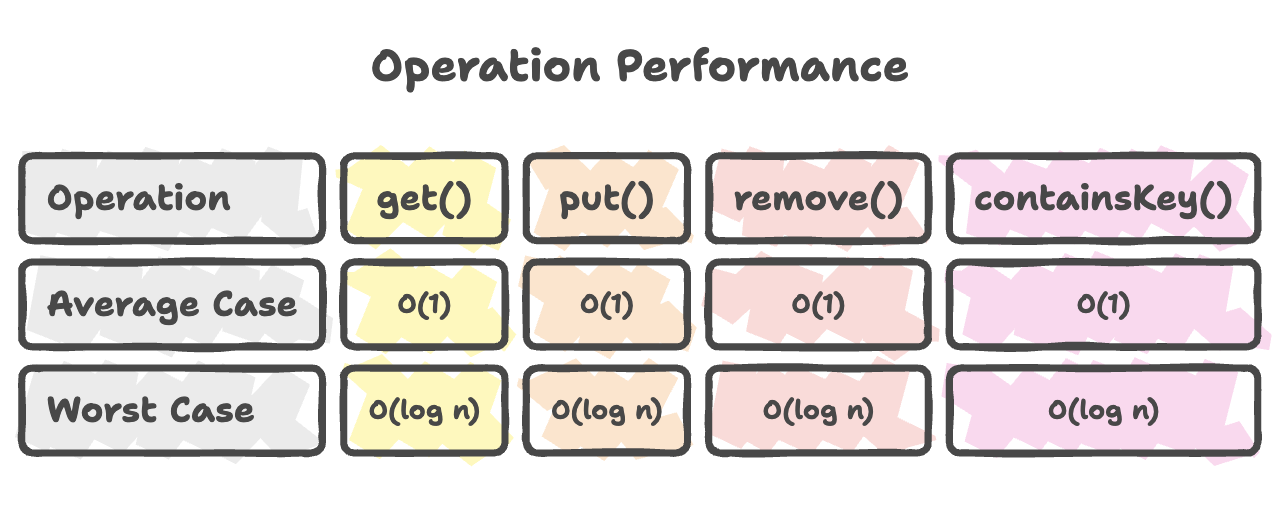
Time Complexity
Concurrency
Reads:
- Unlimited concurrent reads
- No blocking
Writes:
- Multiple concurrent writes (different buckets)
- Only blocks threads writing to same bucket
Example:
Thread 1: put("A", 1)  ──┐
Thread 2: put("B", 2)    ├─ Concurrent (different buckets)
Thread 3: put("C", 3)  ──┘

Thread 4: put("A", 4)  ──┐
Thread 5: put("A", 5)    ├─ Sequential (same bucket)
                       ──┘
Practical Examples
Example 1: Thread-Safe Cache
public class UserCache {
    private final ConcurrentHashMap<String, User> cache = new ConcurrentHashMap<>();

    public User getUser(String id) {
        return cache.computeIfAbsent(id, this::loadUserFromDB);
    }

    private User loadUserFromDB(String id) {
        // Expensive database call
        return database.findUserById(id);
    }

    public void invalidate(String id) {
        cache.remove(id);
    }

    public void clear() {
        cache.clear();
    }
}
Example 2: Concurrent Word Counter
public class WordCounter {
    private final ConcurrentHashMap<String, Integer> wordCounts = new ConcurrentHashMap<>();

    public void countWords(String text) {
        String[] words = text.split("\\s+");

        for (String word : words) {
            // Atomic increment
            wordCounts.merge(word, 1, Integer::sum);
        }
    }

    public Map<String, Integer> getMostFrequent(int n) {
        return wordCounts.entrySet().stream()
            .sorted(Map.Entry.<String, Integer>comparingByValue().reversed())
            .limit(n)
            .collect(Collectors.toMap(Map.Entry::getKey, Map.Entry::getValue));
    }
}

// Usage with multiple threads
WordCounter counter = new WordCounter();
ExecutorService executor = Executors.newFixedThreadPool(10);

for (String document : documents) {
    executor.submit(() -> counter.countWords(document));
}
Common Pitfalls
1. Compound Operations Without Atomicity
// Wrong: Two separate operations = race condition
if (map.containsKey(key)) {
    map.put(key, newValue);
}

// Correct: Single atomic operation
map.replace(key, oldValue, newValue);
2. Iterating and Modifying
// Careful: Modifications during iteration may not be visible
for (String key : map.keySet()) {
    map.put(newKey, newValue);  // May or may not be seen in this iteration
}
3. Assuming Exact Size
// Wrong: Assuming exact size
if (map.size() == 0) {
    // Another thread might have added elements!
}

// Better: Use isEmpty()
if (map.isEmpty()) {
    // Still not guaranteed, but more appropriate
}
Summary
- ConcurrentHashMap is a highly scalable, thread-safe implementation of the
Mapinterface designed for efficient concurrent access without locking the entire map. - It achieves high performance through lock-free reads using volatile variables and fine-grained synchronization (CAS and bucket-level locking) for write operations.
- The map supports atomic compound operations such as
putIfAbsent,compute, andmerge, enabling safe updates in multi-threaded environments. - Iterators are weakly consistent, meaning they reflect the state of the map at some point during iteration without throwing
ConcurrentModificationException. - Due to its high concurrency, scalability, and thread safety, ConcurrentHashMap is commonly used in caches, shared data structures, counters, and other multi-threaded applications.
Written By: Muskan Garg
How is this guide?
Last updated on