
CopyOnWriteArrayList
Introduction
CopyOnWriteArrayList is a thread-safe implementation of the List interface available in the java.util.concurrent package.
It follows the copy-on-write principle, where every modification operation creates a new copy of the underlying array instead of modifying the existing one. This design enables safe concurrent access without requiring synchronization for read operations.
Because of this behavior, CopyOnWriteArrayList is most suitable for applications where read operations are much more frequent than write operations.
Use cases include:
- Event listener lists
- Observer pattern implementations
- Configuration lists
- Plugin systems
Problem with ArrayList in Concurrent Environments
ArrayList is not thread-safe. When multiple threads modify it simultaneously, several issues can occur:
- Data corruption due to race conditions
ConcurrentModificationExceptionduring iteration- Need for manual synchronization
Example:
List<String> list = new ArrayList<>();

// Thread 1
list.add("A");

// Thread 2
list.add("B");
Because modifications are not synchronized, the list may enter an inconsistent state.
Limitations of Synchronized Collections
A common solution is:
List<String> list = Collections.synchronizedList(new ArrayList<>());Although this ensures thread safety, it introduces limitations:
- Iteration must be manually synchronized
- Readers block when writers modify the list
- High contention in multi-threaded environments
This results in reduced concurrency and performance bottlenecks.
Copy-On-Write Strategy
CopyOnWriteArrayList solves these problems by creating a new copy of the array during write operations.
Concept
Original array: [A, B, C]

add("D")

New array created: [A, B, C, D]
The reference to the array is then atomically replaced, and the old array is eventually garbage collected.
Key Idea
- Reads → Access existing array (no locking)
- Writes → Create new array copy
- Iterators → Work on snapshot of array
Internal Structure
Internally, CopyOnWriteArrayList contains:
- A volatile array reference
- A ReentrantLock used during write operations
Simplified structure:
public class CopyOnWriteArrayList<E> {

    private transient volatile Object[] array;
    final transient ReentrantLock lock = new ReentrantLock();

}
Key components:
| Component | Purpose |
|---|---|
| volatile array | Ensures visibility across threads |
| ReentrantLock | Protects write operations |
| immutable snapshot | Enables safe iteration |
Core Operations
1. add()
Write operations create a new array copy.
CopyOnWriteArrayList<String> list = new CopyOnWriteArrayList<>();
list.add("A");
list.add("B");
Process:
- Acquire lock
- Copy existing array
- Add new element
- Replace array reference
- Release lock
Time Complexity: O(n)
2. get()
Read operations are lock-free.
String value = list.get(0);Time Complexity: O(1)
Reason:
- Array reference is
volatile - Arrays are immutable after creation
3. remove()
Removing an element also creates a new array copy without that element.
list.remove("A");Time Complexity: O(n)
4. set()
Updating an element also creates a new array copy with modified value.
list.set(0, "Updated");Time Complexity: O(n)
Iterator Behavior (Snapshot Iteration)
Iterators operate on a snapshot of the array taken when the iterator is created.
Example:
CopyOnWriteArrayList<String> list = new CopyOnWriteArrayList<>();

list.add("A");
list.add("B");

Iterator<String> it = list.iterator();

list.add("C");

while(it.hasNext()){
    System.out.println(it.next());
}
Output:
A
B
The iterator does not see element "C", because it works on the snapshot.
Benefits
- No
ConcurrentModificationException - No synchronization needed
- Multiple iterators can run concurrently
Limitation
Iterators may see stale data.
8. Performance Characteristics
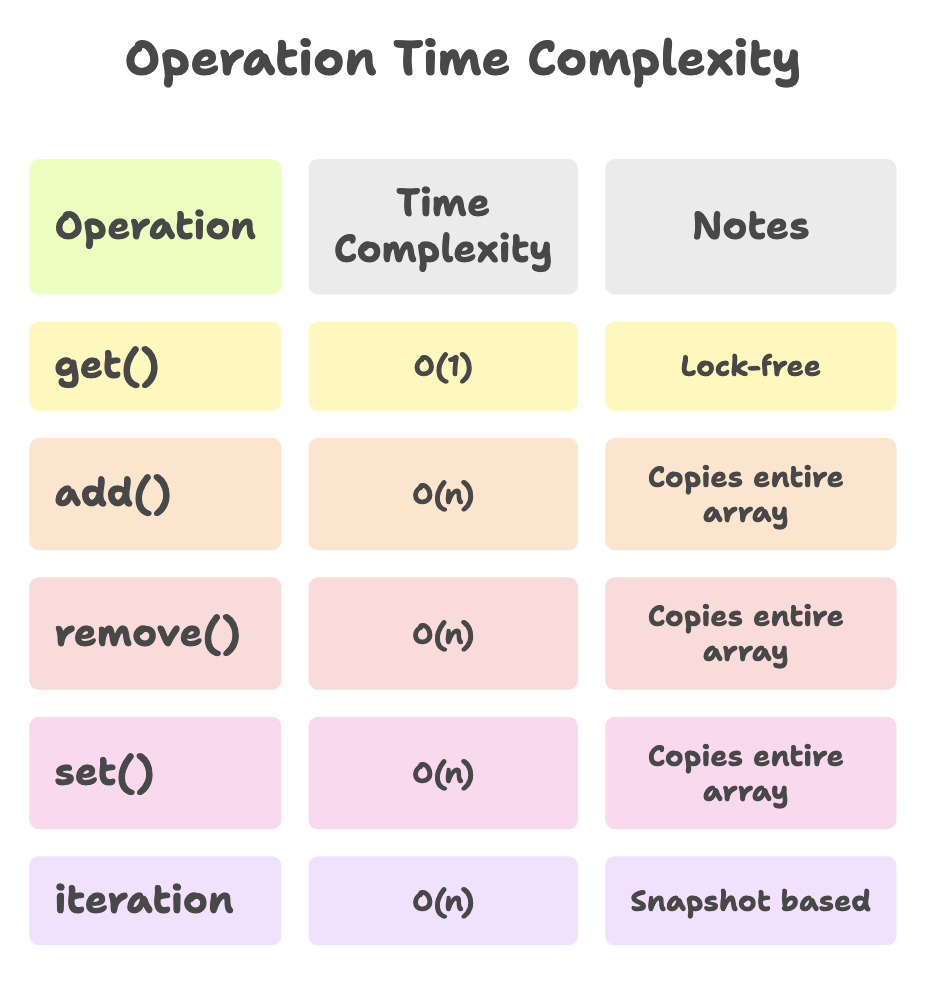
Performance Summary
Reads → very fast Writes → expensive Memory → higher usage due to array copying
9. When to Use CopyOnWriteArrayList
CopyOnWriteArrayList is most effective when:
- Reads greatly outnumber writes
- Thread-safe iteration is required
- List size is relatively small
Common Use Cases
-
Event Listener Systems
-
Observer Pattern
-
Configuration Lists
-
Plugin Systems

Summary
CopyOnWriteArrayListis a thread-safe list implementation that follows the copy-on-write strategy, where every modification creates a new copy of the underlying array while read operations access the existing array without locking.- It provides lock-free read operations and snapshot-based iterators, allowing safe concurrent iteration without throwing
ConcurrentModificationException. - The collection is best suited for read-heavy workloads where read operations significantly outnumber write operations, such as event listener lists, observer patterns, and configuration data.
- Write operations like
add,remove, andsetare relatively expensive because they require copying the entire array, resulting in O(n) time complexity. - Due to frequent array copying, this collection can introduce higher memory overhead and is not suitable for large lists or write-intensive applications.
CopyOnWriteArrayListoffers excellent concurrency for reads and safe iteration but must be used carefully, considering the trade-off between fast reads and costly write operations.
Written By: Muskan Garg
How is this guide?
Last updated on