
REST API Requests
REST (Representational State Transfer) is a standard format for transferring data between a client and a server. It uses JSON (JavaScript Object Notation) as the data exchange format.
JSON - The Data Format
JSON structures data as key-value pairs using objects and arrays.
Supported Value Types
| Type | Example |
|---|---|
| String | "name": "Akshay" |
| Number | "age": 29 |
| Boolean | "active": true |
| Null | "address": null |
| Nested Object | "profile": { "city": "Delhi" } |
| Array | "skills": ["Java", "Python"] |
Example JSON Object
{
  "id": 1,
  "name": "Muskan",
  "username": "muskan",
  "age": 20
}
Anatomy of a REST Endpoint
An endpoint is the location where an API can be accessed.
Every endpoint consists of two parts:
Endpoint = HTTP Method + Path
- Method - Defines the operation (GET, POST, PUT, PATCH, DELETE)
- Path - The URL through which data is accessed or submitted
Endpoint Structure:
METHOD /pathExample:
GET /usersUnderstanding Request Components
1. HTTP Method
The method defines:
What action should be performed on the resource.
Common HTTP Methods
| Method | Path | Purpose |
|---|---|---|
GET | /users | Retrieve all users |
GET | /users/{id} | Retrieve a specific user by ID |
POST | /users | Create a new user (data sent in body) |
PUT | /users/{id} | Replace the entire user record |
PATCH | /users/{id} | Partially update specific fields |
DELETE | /users/{id} | Delete a user |
2. Path (URL)
The path identifies:
Which resource the API should access.
Example:
/users
/products
/orders
3. Headers
Headers contain:
Metadata about the request.
Example:
Content-Type: application/jsonThis tells the server:
- the request body contains JSON data.
4. Request Body
The body contains:
- actual data being sent to the server.
Usually used with:
- POST
- PUT
- PATCH
Difference between PUT vs PATCH
PUT (Full Replacement)
Replaces the entire resource. Any field not included in the request body will be set to its default or null value.
// Original
{ "id": 1, "name": "Muskan", "username": "muskan", "age": 20 }

// PUT request body (only sending username)
{ "username": "muskan_new" }

// Result - other fields lost
{ "id": 1, "name": null, "username": "muskan_new", "age": null }
PATCH (Partial Update)
Updates only the specified fields. All other fields remain unchanged.
// PATCH request body
{ "username": "muskan_new" }

// Result - only username changes
{ "id": 1, "name": "Muskan", "username": "muskan_new", "age": 20 }
Use PUT when replacing an entire resource. Use PATCH when modifying specific fields.
Nested APIs
When entities have relationships (e.g., users, blogs, comments), APIs can be structured using nesting to express those relationships clearly.
Example - Blog Application
| Endpoint | Method | Purpose |
|---|---|---|
/users | GET, POST | List or create users |
/users/{id} | GET, PUT, PATCH, DELETE | Operate on a specific user |
/blogs/{id}/comments | GET | Get all comments on a specific blog |
/users/{id}/comments | GET | Get all comments by a specific user |
/comments/{id} | PATCH, DELETE | Update or delete a specific comment |
Nesting vs Filtering
| Approach | When to Use | Example |
|---|---|---|
| Nesting | Clear, direct relationship between two entities | /blogs/{id}/comments |
| Filtering | Complex relationships, pagination, or multi-criteria lookups | /comments?post_id=123 |
Filtering uses query parameters to narrow down results based on conditions.
How to Pass Data to an Endpoint
There are three ways to send data in a REST API request:
| Method | Use Case | Visibility | Example |
|---|---|---|---|
| Path Parameter | Pass IDs, slugs, or unique identifiers | Exposed in URL | /users/42 |
| Query Parameter | Filtering, sorting, pagination | Exposed in URL | /users?age=20&sort=name |
| Request Body | Sensitive or complex data (credentials, payloads) | Hidden from URL | { "username": "muskan", "password": "***" } |
Security Note
Path parameters and query parameters are visible in the URL. Never pass sensitive information (passwords, tokens) through them. Always use the request body for sensitive data.
Summary
-
REST APIs enable standardized communication between systems using HTTP methods, resource-based URLs, and lightweight JSON data exchange.
-
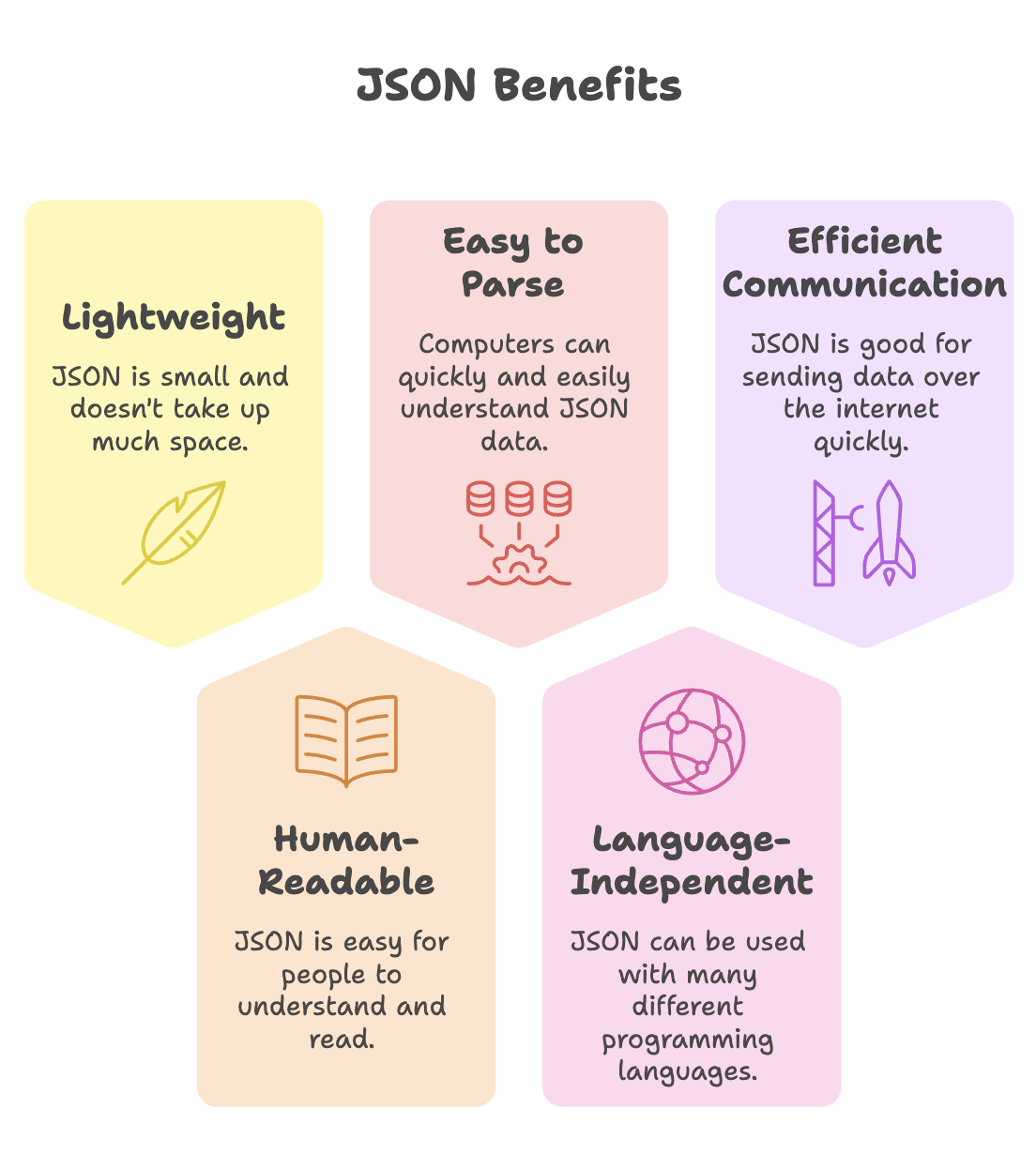
JSON is the preferred data format in REST APIs because it is lightweight, human-readable, and easy to parse across different platforms and programming languages.
-
HTTP methods such as GET, POST, PUT, PATCH, and DELETE are used to perform CRUD operations on resources in a structured and scalable manner.
-
Understanding the difference between PUT (complete replacement) and PATCH (partial update) is essential to prevent unintended data loss and optimize request payloads.
-
Nested routes improve clarity when representing parent-child relationships, while query parameters are ideal for filtering, sorting, searching, and pagination.
-
Sensitive information should never be exposed through URLs or query parameters; instead, secure data should always be transmitted through the request body.
Written By: Muskan Garg
How is this guide?
Last updated on