
Types of Interface
1. Introduction
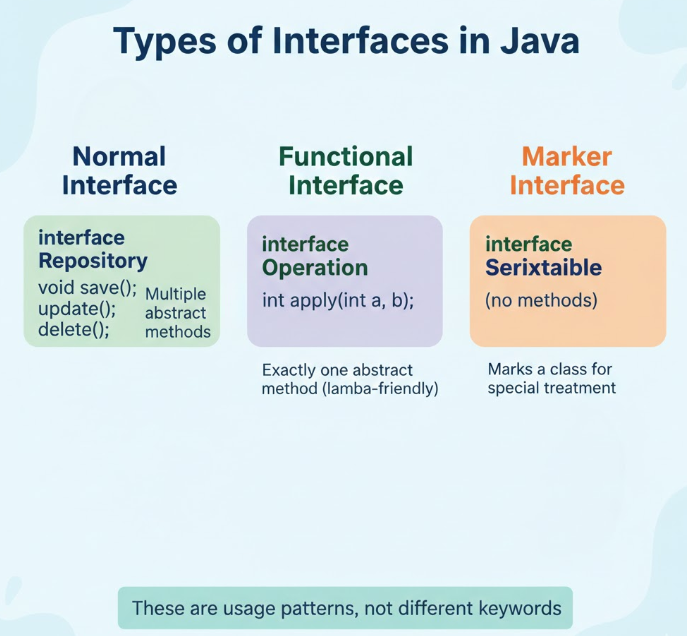
When people say “types of interfaces in Java”, they usually mean interfaces categorized by how they are used in design, not by a special keyword in Java syntax.
Java technically has one interface keyword, but in real-world development, interfaces fall into common patterns.
Understanding these patterns helps you choose the correct interface style when designing code.
This lecture covers the most practical and commonly taught interface types:
- Normal Interface
- Functional Interface
- Marker Interface
Each type solves a different design purpose.
2. Normal Interface (Multiple Abstract Methods)
A normal interface contains more than one abstract method.
It describes a full contract with multiple behaviors.
Example:
interface Repository {
    void save();
    void update();
    void delete();
}
Why this exists:
- Some contracts are naturally multi-step.
- It groups related operations into one standard.
Where it is used:
- Layered applications (service contracts, repository contracts)
- APIs that expose multiple related operations
3. Functional Interface (Exactly One Abstract Method)
A functional interface contains exactly one abstract method. This matters because such interfaces can be used with lambda expressions.
Example:
interface Operation {
    int apply(int a, int b);
}
Why this exists:
- It represents one “action” or “behavior” cleanly.
- Makes functional programming style possible in Java.
Common built-in examples:
Runnable→run()Callable<T>→call()Comparator<T>→compare()
Functional interfaces will be covered in depth in functional-interface.mdx.
4. Marker Interface (No Methods)
A marker interface has no methods at all. It only marks a class as having some special property so frameworks or Java runtime can treat it differently.
Example:
interface Serializable { }If a class implements it, it tells the JVM/framework:
- “This object can be converted into bytes and stored/transferred”
Other common marker interface:
Cloneable
Marker interfaces will be explained deeply in marker-interface.mdx.
5. Can Interfaces Also Have Default/Static Methods?
Yes, modern Java allows:
defaultmethodsstaticmethodsprivatehelper methods (inside interface)
But these do not create a “new type of interface”. They are features that can be used in any interface.
Examples:
interface Logger {
    default void info(String msg) {
        System.out.println("INFO: " + msg);
    }

    static void banner() {
        System.out.println("Logger Started");
    }
}
Default and static methods are covered in dedicated lectures.
6. Why This Classification Matters
In real projects, you choose the interface type based on intent:
- Normal interface → when you need a complete contract with multiple operations
- Functional interface → when you want a single action, often used with lambdas
- Marker interface → when you want metadata-like tagging for runtime/framework behavior
These are design decisions that affect clarity and maintainability.
7. Quick Practical Examples (One Line Each)
7.1 Normal Interface
interface CrudService { void create(); void read(); void update(); void delete(); }7.2 Functional Interface
interface Transformer { String transform(String input); }7.3 Marker Interface
interface Auditable { } // used by framework logic to apply auditing8. Common Mistakes
8.1 Calling everything “functional interface”
Just because an interface has one method does not automatically mean it is used as a functional design unless intended.
To make the intent clear, Java provides @FunctionalInterface annotation (covered later).
8.2 Expecting marker interfaces to enforce methods
Marker interfaces do not enforce behavior through methods. They are used for framework/runtime checks.
9. Summary
-
Java interfaces are commonly categorized by usage:
- Normal interface: multiple abstract methods
- Functional interface: exactly one abstract method (supports lambdas)
- Marker interface: no methods, used for tagging
-
Default/static methods are features, not separate interface types.
-
Choosing the right interface type makes designs cleaner and more maintainable.
Written By: Shiva Srivastava
How is this guide?
Last updated on