
Abstract Method
1. Introduction
An abstract method is a method that defines a required capability but intentionally leaves the implementation empty, because the correct logic depends on the specific child class.
Think of it as Java’s way of enforcing a design rule:
“If you extend this base type, you must provide this behavior.”
This is extremely useful when you want consistency across multiple related classes without forcing one incorrect default implementation.
2. What Is an Abstract Method?
An abstract method has:
- The
abstractkeyword - Only the method signature (no body)
- Ends with a semicolon
;
Example:
abstract class Shape {
    abstract double area();
}
Here, every Shape must have an area() method, but Java does not assume one formula.
3. Why Abstract Methods Are Needed
Abstract methods exist because many systems have a common type but different behavior per subtype.
Example categories where this naturally happens:
Payment→ UPI, Card, NetBanking (each processes differently)Employee→ Developer, Tester, Manager (each “work” differs)Notification→ Email, SMS, Push (each sends differently)
If you write a normal method in the parent, you risk shipping a wrong default. If you don’t define the method at all, you lose a reliable contract and polymorphism becomes harder to use safely. An abstract method solves both: the method exists, and the child must define it correctly.
4. Rules and Restrictions (Very Important)
4.1 Must be inside an abstract class (or interface)
abstract class A {
    abstract void show();
}
4.2 Child class must override it (or child becomes abstract)
If a child does not implement all abstract methods, it cannot be a concrete class.
4.3 Modifiers that are not allowed
private(child must access and override it)final(final prevents overriding)static(static is class-level, not polymorphic overriding)
5. Core Example: Mandatory Override + Polymorphism
abstract class Animal {
    abstract void sound();
}

class Dog extends Animal {
    @Override
    void sound() {
        System.out.println("Bark");
    }
}

class Cat extends Animal {
    @Override
    void sound() {
        System.out.println("Meow");
    }
}

public class Main {
    public static void main(String[] args) {
        Animal a1 = new Dog();
        Animal a2 = new Cat();

        a1.sound();
        a2.sound();
    }
}
Output:
Bark
Meow
This is the key advantage: code written using the parent type (Animal) remains clean, and runtime behavior still becomes correct per actual object type.
6. Abstract Method With Shared Concrete Logic
In most real designs, the abstract class provides both:
- Common logic (already implemented)
- Abstract methods (must be implemented)
abstract class Payment {
    void receipt(double amount) {
        System.out.println("Receipt generated for: " + amount);
    }

    abstract void pay(double amount);
}

class UpiPayment extends Payment {
    @Override
    void pay(double amount) {
        System.out.println("Paid using UPI: " + amount);
    }
}
This design is strong because it reduces duplication while still forcing correctness where logic differs.
7. Design Benefit: Safety and Consistency
When you introduce abstract methods, you make your system safer:
- Every child must implement required behavior, so incomplete implementations are blocked at compile time.
- Common code can call the abstract method confidently, knowing it exists.
- You create a stable base contract that makes your codebase more maintainable as it grows.
In large projects, this becomes one of the simplest ways to avoid inconsistent implementations across different modules or teams.
8. Common Mistakes
8.1 Forgetting to override
abstract class A {
    abstract void show();
}

class B extends A {
    // show() missing -> compilation error
}
8.2 Trying invalid combinations
// abstract final void show();   // invalid
// abstract static void show();  // invalid
// private abstract void show(); // invalid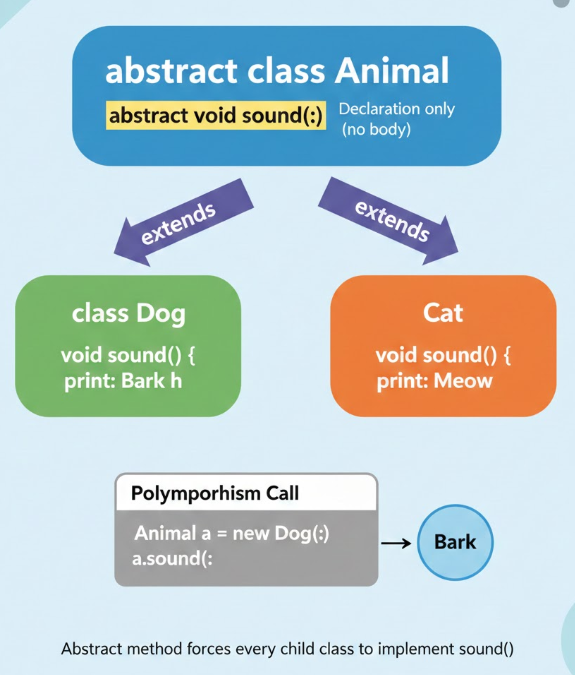
9. Summary
- An abstract method defines a required method without implementation.
- Child classes must implement it to become concrete.
- It enforces consistent design and enables safe polymorphism.
- It cannot be private, static, or final.
- Commonly used when parent defines a contract but each child needs different logic.
Written By: Shiva Srivastava
How is this guide?
Last updated on