
Abstract Class
1. Introduction
An abstract class in Java is a class designed to act as a base blueprint for related classes.
It represents an idea that is too general to create a real object from (for example: Shape, Vehicle, Employee).
In real-world code, you often want a parent class that:
- Shares common state (fields) and common behavior (implemented methods)
- Defines mandatory behavior that every child must follow (via abstract methods)
- Prevents direct object creation so developers don’t misuse the base type
That is exactly where an abstract class fits.
2. What Does “Abstract” Mean in Java?
When you mark a class as abstract, you are telling Java:
- “This class is incomplete as a final real object type.”
- “It exists to be extended, not to be directly created.”
abstract class Shape {
    // common logic + rules for child classes
}
You can still use an abstract class as a reference type:
Shape s = new Circle();This is a powerful OOP idea: you write code using a general type (Shape), and at runtime Java uses the actual object type (Circle).
3. Why Do We Need Abstract Classes?
Abstract classes solve a common design problem: How do we reuse code while still enforcing a standard structure?
Imagine you are building a drawing application. Every shape must support “area calculation”, but the formula differs. If you put everything in normal parent methods, children might forget to override and the system becomes incorrect. If you put everything in interfaces only, you lose the ability to share common fields and common code easily.
An abstract class sits in the middle:
- It can enforce rules for children.
- It can also provide default reusable code to reduce duplication.
This is why abstract classes are widely used in frameworks, libraries, and enterprise codebases.
4. Key Characteristics of an Abstract Class
4.1 You cannot create an object directly
// Shape s = new Shape(); // Not allowedThis prevents misuse. If a type is meant only as a base concept, Java blocks direct instantiation.
4.2 It can contain both complete and incomplete behavior
An abstract class can contain:
- Concrete methods (already implemented)
- Abstract methods (only declared, implemented by child)
In this lecture, focus is on the abstract class as a base type. Abstract methods are covered in detail in the next lecture.
5. Basic Example (Minimal)
abstract class Vehicle {
    void startEngine() {
        System.out.println("Engine start sequence initiated...");
    }
}

class Car extends Vehicle {
    // inherits startEngine()
}

public class Main {
    public static void main(String[] args) {
        Vehicle v = new Car();
        v.startEngine();
    }
}
Here, Vehicle acts as a base category. You don’t create Vehicle directly, but you can store child objects in a Vehicle reference.
6. Abstract Class as a “Template” for Child Classes
A very practical usage of abstract classes is defining a template flow that every child follows. This is common in real projects where the overall algorithm is the same, but some steps differ.
abstract class ReportGenerator {

    // Template method: fixed overall flow
    final void generateReport() {
        fetchData();
        formatData();
        export();
    }

    // Common step (shared implementation)
    void fetchData() {
        System.out.println("Fetching data from database...");
    }

    // Steps that vary by child
    abstract void formatData();
    abstract void export();
}

class PdfReport extends ReportGenerator {
    @Override
    void formatData() {
        System.out.println("Formatting data for PDF...");
    }

    @Override
    void export() {
        System.out.println("Exporting PDF report...");
    }
}
Why this is useful:
- The base class ensures everyone follows the same report pipeline.
- Child classes customize only the parts that differ.
finalprevents child classes from breaking the flow by overriding the main pipeline method.
7. Constructors in Abstract Classes
Abstract classes can have constructors. Even though you cannot instantiate the abstract class directly, the constructor is executed when a child object is created.
This is used to initialize shared fields.
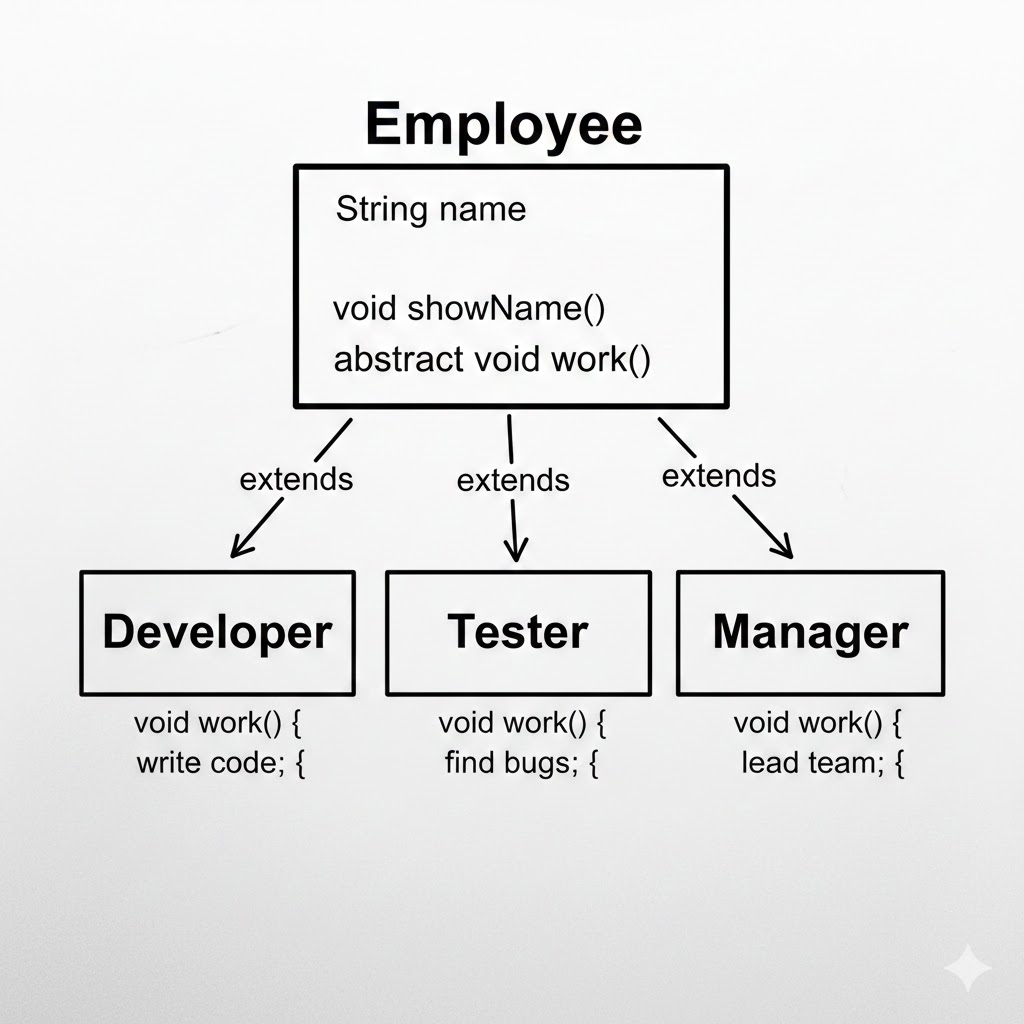
abstract class Employee {
    String name;

    Employee(String name) {
        this.name = name;
    }

    void showName() {
        System.out.println("Employee: " + name);
    }
}

class Developer extends Employee {
    Developer(String name) {
        super(name);
    }
}

public class Main {
    public static void main(String[] args) {
        Employee e = new Developer("Shiva");
        e.showName();
    }
}
This improves consistency because every Employee-type object always has a properly initialized name.
8. What Can an Abstract Class Contain?
An abstract class can contain:
- Instance variables (fields)
- Constructors
- Concrete methods
- Abstract methods
staticmethodsfinalmethodsstaticblocks
Example overview:
abstract class Base {
    int x = 10;

    Base() {
        System.out.println("Base constructor called");
    }

    static void info() {
        System.out.println("Static method in abstract class");
    }

    final void fixedLogic() {
        System.out.println("This cannot be overridden");
    }

    abstract void mustImplement();
}
9. Important Rules and Restrictions
- If a class has at least one abstract method, the class must be abstract.
- A child class must implement all abstract methods, or the child must also be abstract.
- Abstract class cannot be
final(becausefinalblocks inheritance, and abstract requires inheritance). - Abstract methods cannot be
private(because children must override them). - Abstract methods cannot be
static(static methods belong to class, not objects, so overriding does not work the same way).
10. When to Use Abstract Class vs Normal Class?
Use an abstract class when:
- You want to share common code + common state across related classes
- You want to enforce a base structure so child classes can’t “skip required behavior”
- You want to prevent direct object creation of the base type
Use a normal class when:
- The parent type can represent a real object by itself
- There is no “incomplete” behavior that must be implemented in children
11. Common Mistakes
11.1 Trying to instantiate abstract class
// new ReportGenerator(); // not allowed11.2 Putting too much logic in the base class
If the abstract class becomes too large, child classes become tightly coupled and the design becomes hard to maintain. Keep only truly common logic in the abstract base.
11.3 Using abstract class when interface is better
If you only need a contract (rules) and no shared code/state, an interface is usually a better choice.
12. Summary
An abstract class is a base blueprint that cannot be instantiated directly. It helps you combine two important things: code reuse (shared implementation) and design enforcement (rules for children). It is best used when classes are strongly related and share common state and behavior, but still need customized implementations in child classes.
Written By: Shiva Srivastava
How is this guide?
Last updated on