
NLP and How It Evolved
Understand what natural language processing is, why computers need it, and how it moved from hand-written rules through statistics, machine learning and deep learning to the transformers behind today's large language models.
You send a friend the message "I'm running late". Your friend understands at once that you are not out jogging. You will arrive later than planned.
Send the same sentence to a computer and nothing of the sort happens. A computer does not understand words, sentences or what they mean. It is built to work with numbers, with binary data and with exact instructions. Human language is none of those.
The technology that closes this gap is Natural Language Processing, or NLP. It is one of the main technologies behind applications such as ChatGPT, Gemini and Claude.
What the name means
NLP is the field of AI that teaches machines to work with human language. The name has two parts.
| Part | Meaning |
|---|---|
| Natural language | The languages people have developed over time and use for everyday communication: Hindi, Kannada, Tamil, Telugu, Spanish, French, English and all the others |
| Processing | Reading and writing that language: understanding the text that comes in and producing text that goes out |
A natural language is different from a programming language. Java, Python, C and C++ are languages we invented to give exact instructions to a machine. They are precise on purpose. Natural languages are not.
You already use NLP every day:
- Gmail suggests the next words while you write an email.
- A voice assistant understands a spoken question.
- A translation tool turns one language into another in an instant.
- A chat assistant holds a conversation with you.
NLP is a bridge between people and machines. With it, you can instruct a machine in your own language, and you do not have to learn the machine's language.
Why it was hard
Human language is unpredictable. Take a simple wish and see how many ways there are to say it:
- "I want to book a flight ticket."
- "I need a flight ticket."
- "I want to fly to Pune."
Different words, the same intention. A system that deals with language has to handle all of them, and thousands more that nobody thought of. How NLP learned to do that is a story in five stages.
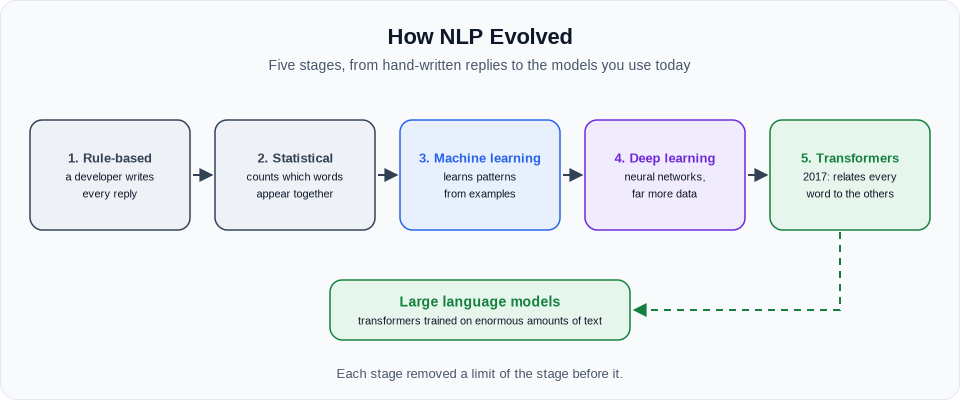
Stage 1: Rule-based NLP
The first systems did not understand language at all. If you typed "hello" and got "Hi, how are you?", it was because a developer had written exactly that: for this input, return this output. Ask "What's your name?" and another hand-written rule answered.
Every reply was coded in advance. That works for a handful of sentences and breaks down immediately afterwards. Nobody can write a rule for every way of asking for a flight ticket, and then for every other topic in the world.
Stage 2: Statistical NLP
The next idea was to stop writing rules and to count. Researchers took large amounts of text and calculated which words usually appear together.
That was better than hand-written rules. A system based on counting still did not understand the language or the context of a sentence.
Stage 3: Machine learning
With machine learning, models were trained on large amounts of text. They no longer relied on rules that people had defined. They learned patterns from examples, and with more data they became better.
Stage 4: Deep learning
As the amount of data kept growing, a stronger way of training was needed. Deep learning, with the neural networks from the previous page, could take in far more data and found patterns in it much better. It was a big step forward for understanding language.
One weakness remained. These networks had trouble with the relationship between words, above all in long sentences. A word near the end of a long text often depends on a word near the beginning, and the networks of that time lost that connection.
Stage 5: Transformers
In 2017 a new architecture was introduced that changed everything: the transformer.
A transformer understands context by looking at how the words in a sentence relate to each other, and it does that far better than anything before it. How it works is the subject of Transformers and Attention.
Researchers then trained transformer models on enormous amounts of text: books, websites, documentation and many other sources. Those models are what we now call large language models. Every LLM you use today has a transformer inside.
The whole path
| Stage | How it worked | What was missing |
|---|---|---|
| Rule-based | A developer wrote every reply by hand | Language has far too many variations |
| Statistical | Counted which words appear together | No real understanding of meaning or context |
| Machine learning | Learned patterns from text examples | Limited by the amount of data it could use well |
| Deep learning | Neural networks, trained on much more data | Lost the relationship between distant words |
| Transformers | Looks at how all words in the text relate | This is the architecture of today's LLMs |
LLMs did not appear overnight. They are the result of each stage fixing a weakness of the stage before it.
What LLMs can do with language
With the transformer, NLP reached a new level. One model can now:
- summarise a document
- translate between languages
- write and explain code
- answer questions
- hold a conversation
Before LLMs, each of these was a separate system that had to be built and trained for one task. Today one model does all of them, and it is that model we will call from Java.
Try It Yourself
- Write five different sentences that all mean "show me my order status". Then imagine writing rules for them. How many more sentences would you still miss?
- Find three features in applications you use that are NLP at work.
- Take the sentence "I saw her duck". Write down the two meanings it can have. What would a program need in order to pick the right one?
- Explain to someone, without notes, why counting which words appear together is not the same as understanding a sentence.
- Put the five stages in order from memory and name the weakness that led from each stage to the next.
Official references
- Attention Is All You Need (the 2017 transformer paper)
- Google Machine Learning Crash Course: large language models
- Hugging Face LLM course: natural language processing
Written By: Shramik Masti
How is this guide?
Last updated on
AI, ML, Deep Learning and Generative AI
See how AI-powered applications differ from traditional rule-based programs, how artificial intelligence, machine learning, deep learning and generative AI fit inside each other, and what a neural network does.
LLMs, Tokens and the Context Window
Break down what a large language model is, how it reads text as tokens and not as words, why cost is counted in tokens, and what the context window limits.