
Embeddings, Vectors and Dimensions
Follow a sentence from tokens to token IDs to embeddings, and understand what a vector and its dimensions are, why similar meanings end up close together, and how that makes semantic search possible.
Can a computer understand the word "Java"? Or "Python", "apple", "cat", "dog"?
No. A computer understands numbers. So before a model can work with a token, the token has to become numbers, and the way that happens explains a lot about why LLMs are good with meaning.
From text to numbers, step by step
Take the sentence "I love Java". You already know the first step from the previous page: tokenization. The video's diagram continues from there.
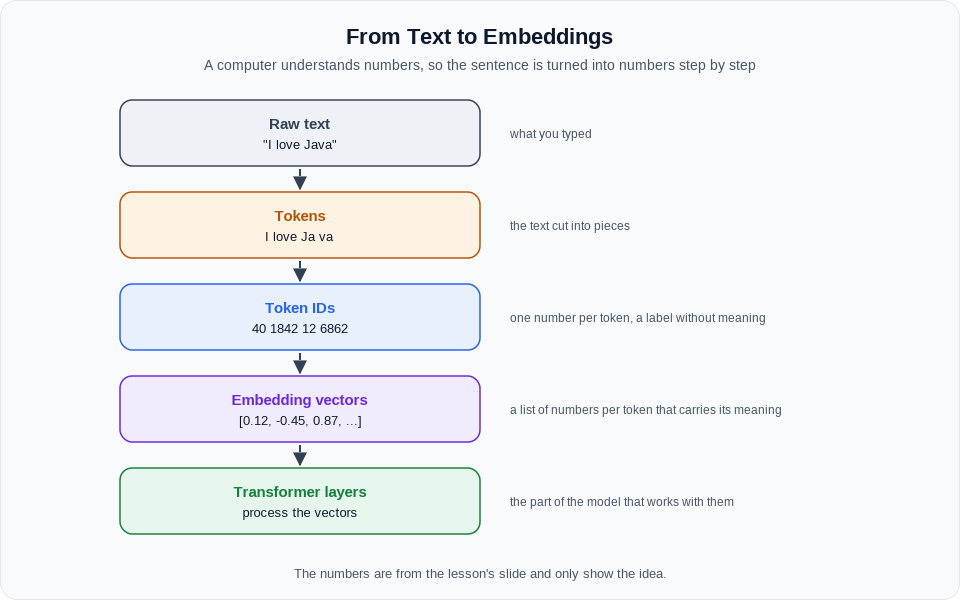
| Step | Example | What it is |
|---|---|---|
| Raw text | "I love Java" | What you typed |
| Tokens | I, love, Ja, va | The text cut into pieces. Here "Java" became two tokens |
| Token IDs | 40, 1842, 12, 6862 | One number per token |
| Embedding vectors | [0.12, -0.45, 0.87, ...] | A list of numbers per token that carries its meaning |
| Transformer layers | The part of the model that processes those vectors |
The numbers in this table are from the slide and are there to show the idea. Real token IDs and embeddings depend on the model.
Token IDs carry no meaning
Every token gets a token ID. It is simply the position of that token in the model's vocabulary, a unique number. In the example, love is 1842.
That number says nothing about love. It does not tell the model that "love" is related to "like", or that it is the opposite of "hate". It is a label and nothing more.
Embeddings carry the meaning
To represent what a token means, each token ID is turned into a much richer set of numbers. That is the embedding.
An embedding is a numerical representation of a word, a sentence or even an entire document that captures its meaning.
You never calculate these numbers yourself, and you do not need to remember any of them. The model learned them during training.
Vectors and dimensions
Two more words belong here, and they are simple once you see them together.
| Term | Meaning |
|---|---|
| Embedding | The numerical representation of a piece of text |
| Vector | The list of numbers in which that representation is stored |
| Dimension | How many numbers the list contains |
So [0.12, -0.45, 0.87] is a vector with three dimensions. A vector with four numbers has four dimensions, one with a hundred numbers has a hundred.
Real embeddings are much longer than the slide can show. They have hundreds or thousands of dimensions. The number 1536 appears on the slide because it is a common size, the default of a widely used OpenAI embedding model.
Why so many? Each dimension can hold a little more information about the text. With more dimensions, a model can capture more of what a token means and more of how it relates to other tokens.
Sizes vary between models
The video mentions 1536 dimensions as a typical size and adds that a model can have fewer or more. The slide lists 768, 1024 and 1536 for real models. Treat these as common examples and not as a rule. Embedding models come in many sizes, for example 384, 768, 1024, 1536 or 3072 dimensions. The size is a property of the model you choose.
Similar meaning, nearby vectors
This is the property that makes embeddings useful.
Take "car" and "automobile". The words look nothing alike, and yet you know they mean the same thing. Their embeddings reflect that. They are not identical, and they are close to each other.
Now take "car" and "banana". Unrelated meanings, and their embeddings are far apart.
If embeddings had only two dimensions, you could draw them as points on a graph:
| Group on the slide | Words | Where they are |
|---|---|---|
| Blue points | Car, Automobile, Vehicle | Close together |
| Red points | Mango, Banana | Close together, and far from the blue group |
The slide sums it up in one line:
Similar meaning = nearby vectors. This distance is what powers semantic search.
Semantic search means searching by meaning and not by matching letters. A search for "automobile" can find a text that only says "car", because their vectors are neighbours. Keyword search cannot do that.
Two places where you meet embeddings
The word "embedding" is used in two situations, and it helps to keep them apart.
| Inside an LLM | From an embedding model | |
|---|---|---|
| What gets an embedding | Every single token of your prompt | A whole sentence, paragraph or document |
| Who uses it | The transformer, on the way to an answer | Your own application, for example to search documents |
| Do you see it | No. It happens inside the model | Yes. You call the model and get the vector back |
This page, like the video, describes the first: what happens to your prompt inside the model. The second is the basis of semantic search and RAG. The idea is the same in both cases: meaning becomes a position in a space of numbers.
Want to try embeddings in Java?
The video does not write embedding code. If you want to create embeddings yourself and compare them, the separate LangChain4j docs do it step by step in Embeddings and Cosine Similarity.
Summary
These are the six points from the video's summary slide:
- Computers understand numbers, not words.
- Every token first gets a token ID.
- That token ID is converted into an embedding.
- An embedding is represented as a vector.
- The number of values in the vector determines its dimensions.
- These embeddings are then processed by the transformer, which learns relationships between them and generates intelligent responses.
And the full flow, from the same slide:
Text -> Tokenization -> Tokens -> Token IDs -> Embeddings (vectors) -> Transformer -> ResponseThe last two steps are the subject of the next page.
Try It Yourself
- Write down four pairs of words that mean the same but share no letters, such as "car" and "automobile". These are the pairs that keyword search fails on.
- Draw two axes on paper. Place "car", "automobile", "vehicle", "mango" and "banana" as points, so that related words are close. Then add "apple" and "truck".
- Explain the difference between a token ID and an embedding in two sentences.
- A vector has 768 numbers. How many dimensions does it have? What do you gain and what do you pay with a vector of 3072 numbers?
- Think of a search box you use that only matches exact words. Describe one search where semantic search would have found what you wanted.
Official references
- OpenAI: embeddings
- Google Machine Learning Crash Course: embeddings
- LangChain4j: supported embedding models
Written By: Shramik Masti
How is this guide?
Last updated on
LLMs, Tokens and the Context Window
Break down what a large language model is, how it reads text as tokens and not as words, why cost is counted in tokens, and what the context window limits.
Transformers and Attention
Learn what the transformer architecture is, how its layers use the attention mechanism and a feed-forward network to understand context, and how an LLM builds an answer one token at a time.